LPWAN Networks for Industry: Architecture, Deployment and Scaling

Why LPWAN, Not Wi-Fi, Cellular or WirelessHART

Requirement Wi-Fi Cellular WirelessHART LPWAN (LoRaWAN)
Range 50–100 m 1–5 km 100–250 m Up to 15 km
Battery life Hours Months 3–5 years Up to 10 years
Subscription No Yes (SIM) No No
Own infrastructure No No No (HART GW) Yes
Basement/manhole penetration Poor Average Average Excellent
Interference resistance Low Average High (FHSS) High (CSS)
Encryption WPA2/3 Operator AES-128 AES-128 (two-level)

Industrial LPWAN Network Architecture

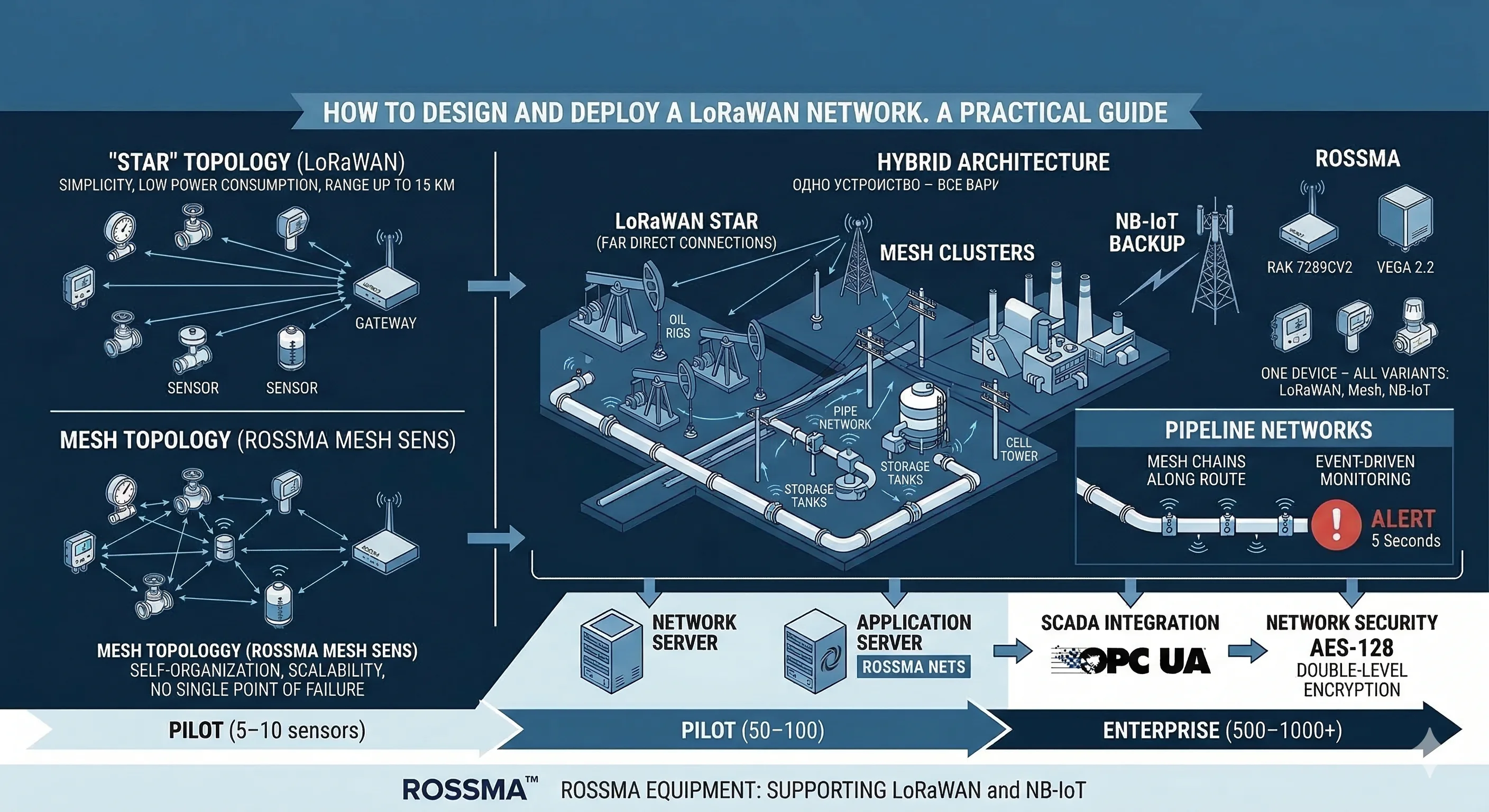
Star Topology β€” Classic LoRaWAN

End devices β†’ Base stations β†’ Network Server β†’ Application Server (ROSSMA NETS). Up to 1000 sensors per base station, range up to 15 km.

Mesh Topology β€” ROSSMA MeshSens

Each node retransmits neighbor data. Self-organizing, no single point of failure, scales as nodes are added. Ideal for dense urban areas and utility infrastructure.

Hybrid Architecture

LoRaWAN star for remote sensors + Mesh clusters for dense groups + NB-IoT backup. ROSSMA equipment supports all three β€” switch via configurator.

Extended Pipelines: Mesh + Event-Driven Monitoring

Mesh Coverage Along Pipeline Routes

Linear Mesh chain of sensors every 0.5–2 km along pipeline. Each node relays to neighbors. Covers pipelines of any length without multiple base stations. Solar-powered for remote sections.

Event-Driven Mode

ROSSMA IIOT-AMS P-METER measures pressure every 5 seconds. Normal = sleep (zero transmission). Threshold exceeded = instant alert. Over 1,000,000 measurements per 14 Ah battery.

ROSSMA Pipeline Leak Detector

ROSSMA Pipeline Leak Detector β€” automatic leak detection by pressure patterns, section-level localization, Telegram/email alerts, SCADA integration via OPC UA/REST API.

ROSSMA IIOT-WellPAD β€” Well Pad Solution

ROSSMA IIOT-WellPAD β€” complete well pad monitoring: field sensors (P-METER, 1-Wire Ex, VPM, Tilt Counter Ex) β†’ LoRaWAN base station β†’ Edge PC (Astra Linux + Kaspersky) β†’ SCADA/MES via VPN.

Parameter Wired APCS ROSSMA WellPAD
Cost per pad –60K –15K
Installation 2–4 weeks 1–2 days
Earthworks Yes No
ROI 3–5 years 12–18 months

Base Station Selection

Parameter VEGA 2.2 RAK 7289CV2
LoRa channels 8 Up to 16
Protection IP65 IP67/NEMA-6
Connectivity Ethernet Ethernet, Wi-Fi, 4G

Coverage Planning

Use ROSSMA LPWAN Network Planner for terrain-aware coverage calculation.

Network Security

AES-128 two-level encryption (NwkSKey + AppSKey), unique keys per device (OTAA), frame counters against replay attacks, private network.

Conclusions

Industrial LPWAN on LoRaWAN: independence, AES-128 security, star/Mesh/hybrid flexibility, 10+ year battery, pilot in 1–2 weeks.

Ready to design? Use ROSSMA Network Planner or contact us.
Utility Automation: Wireless Monitoring of Building Systems

The Problem: Manual Control, Resource Losses and Emergencies

Utility companies, water utilities and heat supply organizations face systemic problems daily that cannot be solved without automation.

Metering and Resource Accounting

  • Manual rounds β€” inspectors visit basements, heat substations, metering nodes, manholes, recording readings by hand
  • Resource losses up to 25–30% β€” discrepancy between building-level and apartment-level meters. Without real-time data, leaks go undetected for weeks
  • Outdated data β€” readings collected once a month, decisions based on month-old information

Pipelines and Manholes β€” the “Blind Zone”

Underground utilities are the most vulnerable part of city infrastructure. Water and heat pipelines run through manholes and collectors where:

  • No connectivity β€” concrete walls, cast iron covers, soil block cellular signal. NB-IoT and GSM don’t work
  • No electricity β€” running a power cable to a manhole costs from $1,000 and requires permits
  • No pressure monitoring β€” pressure drop indicates a leak, but without sensors it’s only discovered when water surfaces
  • No temperature control β€” pipe freezing at -40Β°C in winter, heat main overheating in summer
  • Manhole flooding β€” groundwater, pipe bursts. Flooded manholes mean equipment corrosion

Manhole Cover Access Control

  • Safety hazard β€” pedestrians and vehicles falling into open manholes, lawsuits
  • Theft β€” cast iron covers sold as scrap metal
  • Vandalism β€” unauthorized access, illegal pipe taps

Safety

  • Gas leaks β€” in basements, boiler rooms, gas distribution points
  • Smoke β€” fires in electrical rooms, basements, technical premises
  • No alerts β€” dispatcher learns from residents, not from the system

Solution: Wireless IoT Monitoring

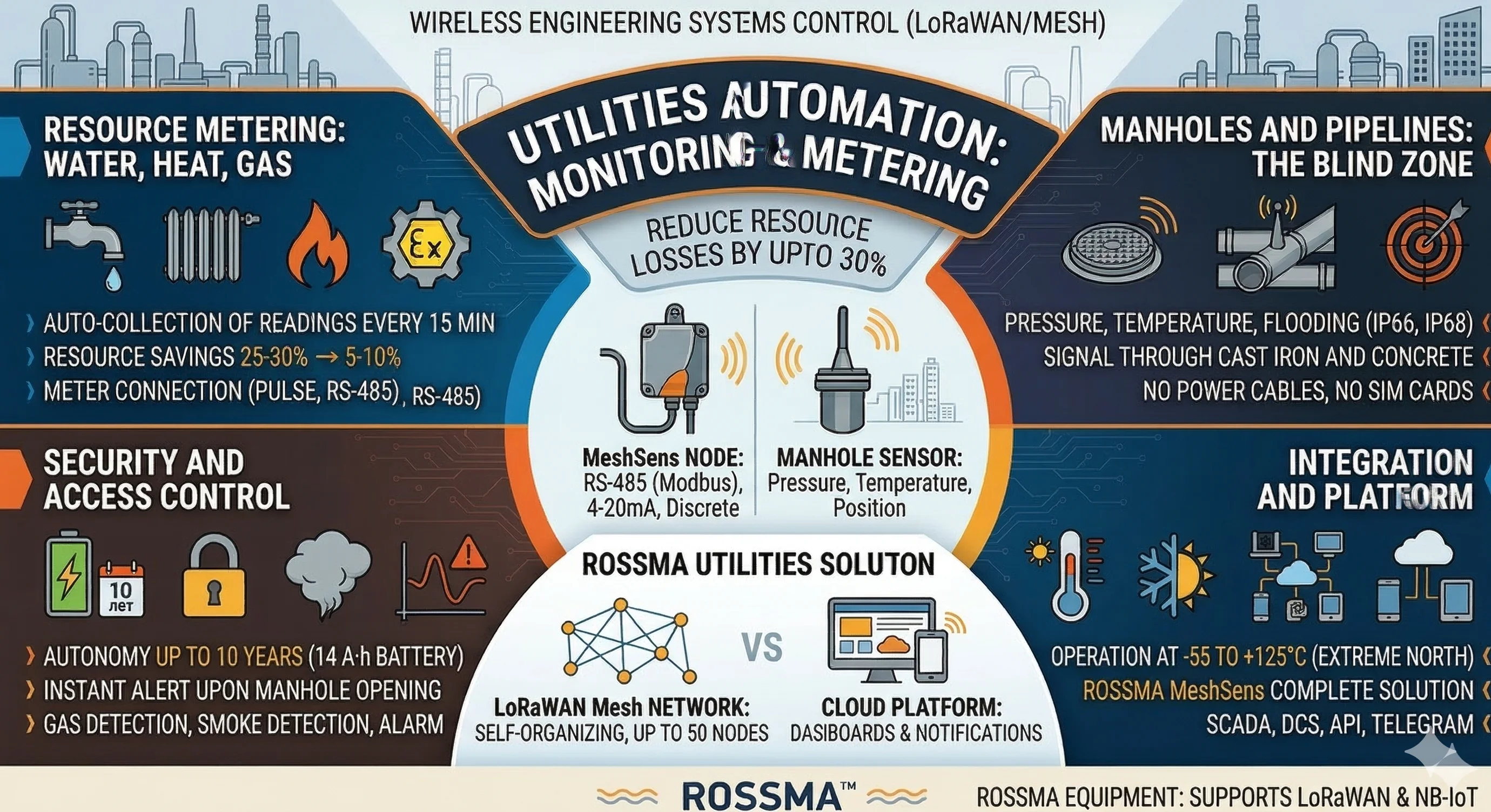
Wireless IoT systems automatically collect data from meters and sensors every 5–60 minutes. Data flows to a cloud platform where the dispatcher sees all facilities on one screen.

What Can Be Monitored

Pipelines in Manholes

  • Pipeline pressure β€” ROSSMA P-METER installed directly in manholes. Β±0.2% accuracy, background monitoring every 5 seconds
  • Heat main temperature β€” ROSSMA 1-Wire with DS18B20 sensors (-55…+125Β°C). Up to 5 measurement points per device
  • Manhole flooding β€” ROSSMA Leak Detector at manhole bottom. Instant alert + audible siren
  • Valve position β€” ROSSMA Dry Contact VPM measures valve opening percentage (0–100%)

Manhole and Cabinet Control

  • Cover opening β€” ROSSMA Dry Contact detects opening/closing, instant alert to dispatcher
  • Theft protection β€” ROSSMA ESD detects vibration, impact, tilt >15Β°

Safety

Economic Impact

Metric Before After IoT
Meter reading Monthly (manual) Every 15 min (auto)
Leak detection Days–weeks Seconds (instant alert)
Resource losses 25–30% 5–10%
Manhole control Quarterly inspection Continuous
Communication cost SIM per device $0 (own LoRaWAN network)
ROI β€” 6–12 months

Conclusions

Utility automation with ROSSMA IoT pays for itself in 6–12 months. Wireless sensors work in manholes, basements, underground β€” where cellular networks fail.

Need a cost estimate? Contact us or use the AI Equipment Selector.

How to Choose a Pressure Sensor for Oil and Gas Industry

Why Choosing a Pressure Sensor Is a Critical Task

At oil and gas facilities, a pressure sensor is not just an instrument β€” it is a safety system element. Incorrect readings or loss of communication can lead to pipeline accidents, equipment damage, or environmental disasters. Selection criteria for oil and gas are fundamentally different from standard industrial applications.

7 Criteria for Choosing a Pressure Sensor for Oil and Gas

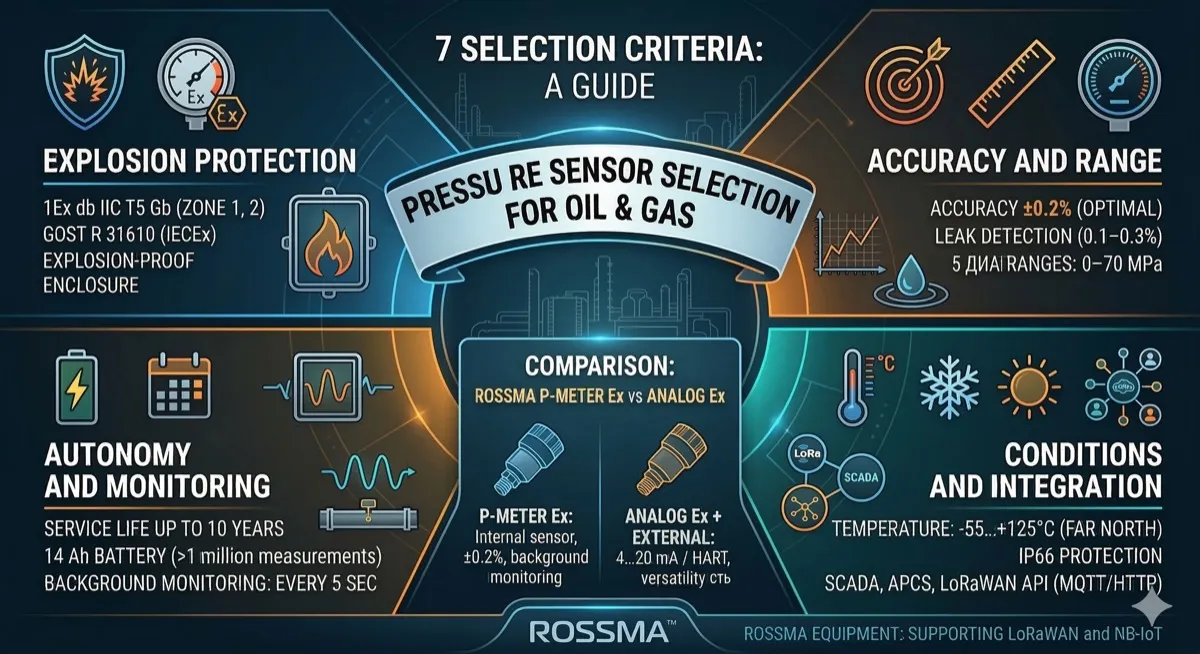
1. Explosion Protection β€” Mandatory Requirement

Oil and gas facilities are classified as Zone 1 and Zone 2 hazardous areas. All equipment must be certified to IECEx / GOST R 31610.

  • Type “d” (flameproof enclosure) β€” most reliable for Zone 1. Marking: 1Ex db IIC T5 Gb
  • Temperature class T5 (up to 100Β°C) is preferable to T4 β€” lower surface temperature
  • Group IIC β€” strictest, includes hydrogen (all oil and gas environments)

ROSSMA P-METER Ex carries marking 1Ex db IIC T5 Gb X β€” flameproof enclosure, group IIC, temperature class T5.

2. Accuracy Class β€” Not All 0.5% Are Equal

In oil and gas, pressure measurement accuracy directly impacts leak detection, production optimization, and safety.

Accuracy Error Oil & Gas Suitability
1.5% Β±1.5% Insufficient for most tasks
0.5% Β±0.5% Minimum acceptable
0.2% Β±0.2% Optimal β€” leak detection, precise metering

ROSSMA P-METER Ex provides Β±0.2% accuracy β€” 7.5Γ— more precise than typical 1.5% solutions.

3. Measurement Range

Available ranges: 0–7 / 0–10 / 0–20 / 0–35 / 0–70 MPa β€” covering all typical oil and gas applications from flowlines to high-pressure gas pipelines.

4. Battery Life β€” Wired vs Wireless

Cable installation in explosion-proof conduit costs from ,000/km and takes months of planning. Wireless sensors with autonomous power solve this problem.

ROSSMA P-METER Ex with 14 Ah battery provides over 1,000,000 measurements. Background pressure monitoring every 5 seconds with virtually zero power consumption β€” data transmitted only when thresholds are exceeded. Real battery life: up to 10 years.

5. Monitoring Mode β€” The Key Differentiator

Background monitoring: sensor wakes every 5 seconds, compares pressure to thresholds. Normal = sleep without transmission. Threshold exceeded = instant alert. Continuous monitoring with minimal battery drain.

6. Temperature Range

Parameter ROSSMA P-METER Ex Typical Competitors
Operating temperature -55…+80Β°C -40…+60Β°C
Media temperature -40…+125Β°C -20…+85Β°C
Protection IP66 IP65

7. Integration with SCADA and Cloud

LoRaWAN Network Server β†’ MQTT/HTTP API β†’ SCADA, ROSSMA NETS, ThingsBoard, Chirpstack.

P-METER Ex vs ANALOG Ex: Which to Choose?

Parameter P-METER Ex ANALOG Ex + external sensor
Accuracy Β±0.2% Depends on sensor (0.5–1.5%)
Background monitoring Yes (every 5 sec) No
Battery life >1,000,000 measurements ~40,000 packets
Flexibility Pressure only Any 4…20 mA sensor
Explosion protection 1Ex db IIC T5 1Ex e IIC T4

Conclusions

7 key criteria for oil and gas pressure sensors: explosion protection (type “d”, IIC, T5), accuracy (0.2%), range, battery life (10 years), background monitoring, temperature range (-55Β°C), and SCADA integration.

Need help choosing? Use AI Equipment Selector or contact us.

LoRaWAN vs NB-IoT: Which Technology to Choose for Industrial IoT

Introduction

When choosing wireless technology for industrial IoT, engineers face a key question: LoRaWAN or NB-IoT? Both technologies belong to the LPWAN (Low Power Wide Area Network) class and provide long-range data transmission with minimal power consumption. However, there are fundamental differences between them that are critically important when selecting a solution for a specific facility.

LoRaWAN Technology

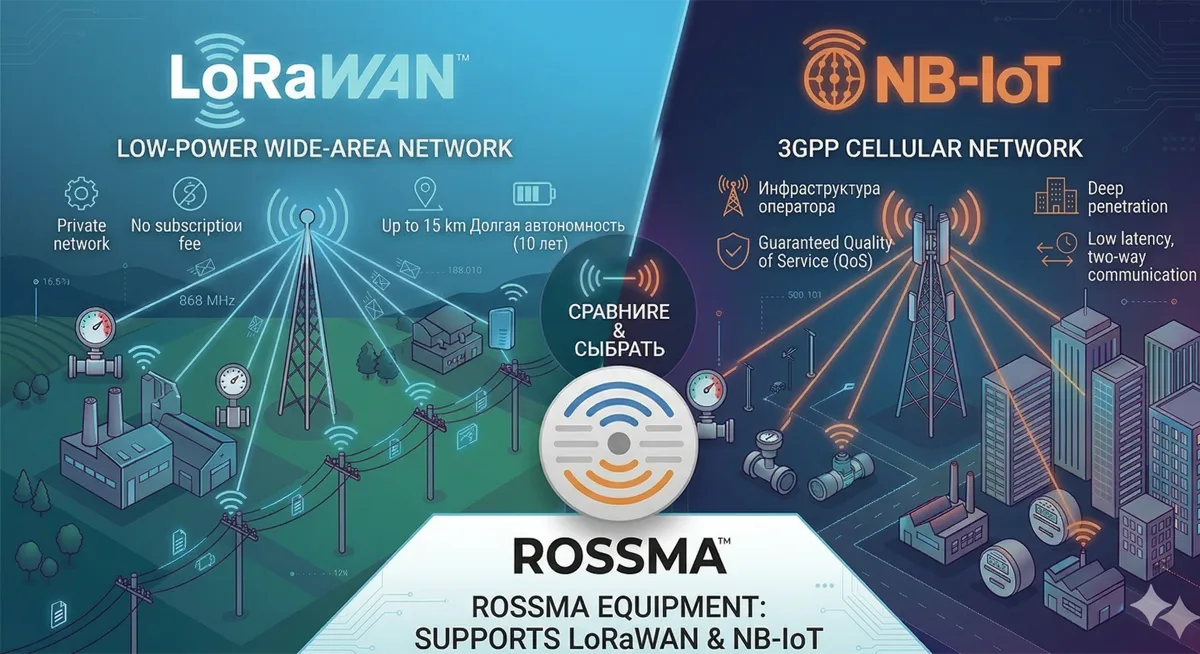
LoRaWAN (Long Range Wide Area Network) is an open protocol developed by the LoRa Alliance. It operates in unlicensed frequency bands (868 MHz in Europe/Russia, 915 MHz in Americas).

Key Advantages of LoRaWAN

Data Security β€” AES-128 Encryption

LoRaWAN provides two-level data protection: network-level encryption (NwkSKey) and application-level encryption (AppSKey) using the AES-128 algorithm. This means even the network operator cannot access user data β€” it is encrypted with a separate key. Each device receives a unique key pair upon activation, preventing mass compromise.

Superior Signal Penetration

Low transmission power (up to 25 mW) is compensated by Spread Spectrum modulation technology (LoRa CSS) β€” interference resistance down to -20 dB below noise level. Thanks to this, LoRaWAN signal reliably penetrates where NB-IoT loses connection:

  • Manholes and collectors β€” reinforced concrete walls and covers are not an obstacle
  • Basements and underground floors β€” stable communication through multiple floors of concrete
  • Underground utilities β€” data transmission from underground at depths up to 1-2 meters
  • Industrial facilities β€” metal structures and equipment create a shielding effect that LoRaWAN overcomes

High Interference Resistance

Chirp Spread Spectrum (CSS) technology at the core of LoRa provides exceptional interference resistance. The signal is spread across a wide frequency band, making it resistant to narrowband interference from industrial equipment, electric motors, frequency converters, and other electrical equipment on site. In industrial environments with high levels of electromagnetic interference, this is a critical advantage over NB-IoT.

Other advantages:

  • Private network β€” full infrastructure control, independence from telecom operators
  • No subscription fees β€” zero communication costs after deployment
  • Range up to 15 km β€” line of sight, 3-5 km in urban areas
  • Battery life up to 10 years β€” 14 Ah battery provides over 1,000,000 measurements
  • Works without cellular coverage β€” at remote fields, forests, and isolated sites

NB-IoT Technology

NB-IoT (Narrowband IoT) is a 3GPP standard that uses existing cellular operator infrastructure. It operates in licensed spectrum.

NB-IoT advantages:

  • Ready infrastructure β€” no need to deploy your own base stations
  • Guaranteed quality of service (QoS) β€” operator standard
  • Bidirectional communication with low latency β€” suitable for control commands

NB-IoT limitations:

  • Operator dependency β€” no coverage = no communication
  • Subscription fee per SIM card
  • Worse signal penetration in difficult conditions (manholes, underground)
  • Higher power consumption β€” battery drains faster
  • Sensitivity to industrial electromagnetic interference

Comparison for Industrial Applications

Parameter LoRaWAN NB-IoT
Encryption AES-128 (two-level) Standard LTE
Basement/manhole penetration Excellent Average
Underground operation Yes (up to 1-2 m) Difficult
Interference resistance High (CSS) Average
Range Up to 15 km Up to 10 km
Battery (14 Ah) Up to 10 years Up to 5 years
Subscription fee None Yes
Own infrastructure Yes No (operator)
Deployment Base station needed Ready immediately

For remote oil and gas facilities, underground utility infrastructure, and industrial sites with high interference levels β€” LoRaWAN is the only viable solution. NB-IoT may be justified in urban conditions with guaranteed cellular coverage and real-time bidirectional communication needs.

ROSSMA equipment supports both technologies β€” LoRaWAN and NB-IoT. This allows choosing the optimal option for a specific site or using a hybrid approach.

Conclusions

For most industrial applications, we recommend LoRaWAN as the primary technology due to:

  • Two-level AES-128 encryption
  • Superior penetration (manholes, basements, underground)
  • High interference resistance in industrial environments
  • No subscription fees
  • Sensor battery life up to 10 years

NB-IoT remains a backup option for sites with reliable cellular coverage. ROSSMA equipment works with both technologies without replacing sensors β€” simply switch the transmission mode.