LoRaWAN vs WirelessHART vs NB-IoT: Choosing the Right Protocol for Industrial Monitoring

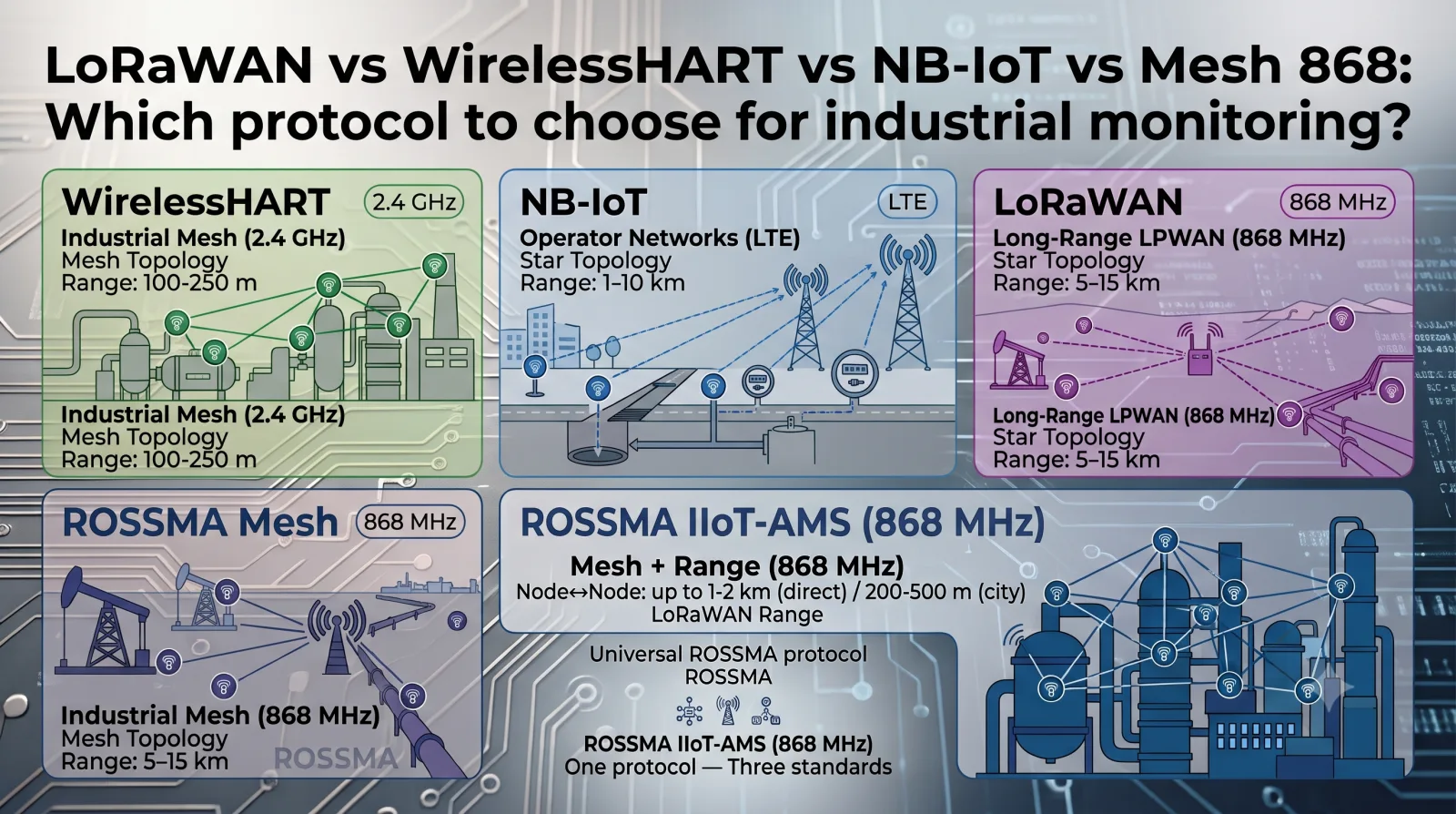
Choosing a wireless communication protocol is one of the first and most critical decisions when designing an industrial monitoring system. WirelessHART, LoRaWAN, and NB-IoT are the three main options, each with its own philosophy, limitations, and economics. Separately, there is ROSSMA’s own mesh network at 868 MHz. This article examines the technical differences and provides practical recommendations for making the choice.

Three Protocols β€” Three Approaches to Industrial IoT

All three protocols solve the same problem β€” wireless data transmission from sensors to a collection platform. But they do it in fundamentally different ways:

  • WirelessHART β€” industrial mesh protocol developed by the HART Communication Foundation. Focus on compatibility with existing HART instruments
  • LoRaWAN β€” LPWAN protocol with an open standard (LoRa Alliance). Focus on range and energy efficiency
  • NB-IoT β€” 3GPP standard, operating through cellular operator infrastructure. Focus on coverage without own infrastructure

WirelessHART: Industrial Standard with Limitations

WirelessHART (IEC 62591) operates at 2.4 GHz and uses mesh topology: each node can relay data from neighboring nodes. Key characteristics:

  • Frequency: 2.4 GHz (ISM, unlicensed)
  • Range: 100–250 m between nodes
  • Topology: Mesh (self-organizing)
  • Max nodes: 100 per gateway
  • Battery: 3–5 years (active relay consumes energy)
  • Throughput: 250 kbps (channel), ~1 kbps per node

Advantages: mesh reliability (multiple routes), backward compatibility with wired HART, standard maturity (since 2007).

Limitations: short range (2.4 GHz poor metal penetration), 100 node limit, high cost (Emerson/ABB ecosystem), limited autonomy due to mesh relay.

NB-IoT: Operator Infrastructure for IoT

NB-IoT (Narrowband IoT) is a 3GPP standard using cellular operator infrastructure (MTS, MegaFon, Beeline, Rostelecom). Characteristics:

  • Frequency: licensed LTE bands (800/900 MHz)
  • Range: 1–10 km (operator-dependent)
  • Topology: Star (device β†’ operator base station)
  • Throughput: up to 50 kbps (downlink), up to 20 kbps (uplink)
  • Battery: 5–10 years (depends on transmission frequency)
  • Monthly fee: 300 β‚½/mo per SIM card

Advantages: no own infrastructure needed, coverage in cities and along highways, licensed spectrum (no interference).

Limitations: operator dependency (vendor lock-in), per-device monthly fee, no coverage in remote areas (oilfields, tundra), latency can be unpredictable.

Related standards: the 3GPP family also includes LTE-M (higher throughput and mobility support than NB-IoT) and the increasingly popular 5G RedCap β€” a “lightweight” 5G for IoT devices. In Russia, operators have deployed them less widely than NB-IoT so far, but this is exactly the direction in which operator LPWAN networks are evolving β€” worth considering for long-term projects.

LoRaWAN: Balancing Range, Autonomy, and Cost

LoRaWAN (Long Range Wide Area Network) is an open standard from the LoRa Alliance using sub-GHz frequencies. Characteristics:

  • Frequency: 868 MHz (RU/EU, unlicensed ISM)
  • Range: 5–15 km (open terrain), 2–5 km (urban)
  • Topology: Star (device β†’ base station)
  • Max nodes: 1,000+ per base station
  • Battery: up to 10 years (no relay, low power consumption)
  • Throughput: up to 50 kbps
  • Monthly fee: 0 β‚½ (own infrastructure)

Advantages: maximum range among the three protocols, 10-year autonomy, thousands of devices per BS, open standard (no vendor lock-in), sub-GHz better wall and metal penetration.

Limitations: own base station required, limited throughput (not for video/audio), ISM band (possible interference in cities).

Comparison Table: Protocols

The fourth column is ROSSMA’s own mesh network at 868 MHz, built on top of LoRaWAN infrastructure (more details in the section below).

Parameter LoRaWAN WirelessHART NB-IoT Mesh 868 (ROSSMA)
Frequency 868 MHz (unlicensed) 2.4 GHz (unlicensed) LTE bands (licensed) 868 MHz (unlicensed)
Range 5–15 km 100–250 m 1–10 km up to 1–2 km (line of sight) / 200–500 m (dense)
Topology Star Mesh Star (operator) Mesh (nodes + base stations, BS-to-BS)
Nodes per BS 1,000+ 100 Operator-dependent hundreds
Battery Up to 10 years 3–5 years 5–10 years up to 10 years
Monthly fee 0 β‚½ 0 β‚½ 300 β‚½/mo (SIM) 0 β‚½
Own infrastructure Yes (BS) Yes (gateway) No Yes (BS/gateway)
Obstacle penetration Excellent Average Good Excellent
Vendor lock-in No (open) Emerson/ABB Telecom operator ROSSMA (single platform)
Latency 1–5 s 1–30 s (TDMA) 1–10 s (unpredictable) 1–10 s
BS/gateway cost 180 000 β‚½ 500 000 β‚½ β€” 180 000 β‚½ / gateway 35 000–125 000 β‚½

ROSSMA: One Protocol β€” Three Communication Standards

A unique feature of the ROSSMA IIoT-AMS platform is a universal protocol operating over multiple physical communication standards. The same sensor can work via:

  • LoRaWAN β€” for sites with own infrastructure (oilfields, factories)
  • NB-IoT β€” for sites in operator coverage areas (urban networks, transport)
  • LTE β€” for high-throughput tasks
  • 868 MHz Mesh β€” for sites without any infrastructure

This means no vendor lock-in at the protocol level. If a site has LoRaWAN deployed and NB-IoT coverage appears later, some of the devices can be migrated without hardware replacement.

868 MHz Mesh β€” A Fourth Option from ROSSMA

Beyond the three standard protocols, ROSSMA offers a proprietary mesh network at 868 MHz. It combines the mesh topology advantages of WirelessHART (reliability, self-healing) with sub-GHz range: the “node-to-node” link works up to 1–2 km in line of sight and 200–500 m in dense development β€” versus 100–250 m for WirelessHART at 2.4 GHz.

Relaying in Mesh 868 works on two levels: between sensor nodes and between base stations, including directly with each other (BS-to-BS). This delivers fault tolerance β€” when one route is lost, traffic is automatically rerouted β€” and lets you expand coverage by adding base stations, without laying backbone infrastructure between them.

Mesh 868 is built on top of the same LoRaWAN infrastructure, so the base station is shared with LoRaWAN (180 000 β‚½), while mesh nodes (relay gateways) cost from 35 000 to 125 000 β‚½ depending on functionality and enclosure. This lets you start with a regular LoRaWAN network and add a mesh segment wherever blind spots or dense metal structures appear β€” without changing the platform.

Optimal for dense sites: refineries, compressor stations, chemical plants, where equipment is close together but reliable communication through metal structures is essential.

Selection Matrix by Industry

Industry / site Recommended protocol Why
Oil & Gas (oilfields) LoRaWAN Long distances, no operator coverage
Oil & Gas (refineries) Mesh 868 or LoRaWAN Dense buildings, metal structures
Utilities (urban) NB-IoT or LoRaWAN Operator coverage in city, distributed sites
Pipelines LoRaWAN Linear site, 5–15 km coverage per BS
District heating NB-IoT Urban infrastructure, low point density
Open-pit mining LoRaWAN Large territory, no operator coverage
Underground mining Mesh 868 No line of sight, relay needed
Smart City NB-IoT or LoRaWAN Coverage, scale, low maintenance

Practical Recommendations

When choosing a protocol, apply three criteria:

  1. Distance β€” if monitoring points are kilometers apart β†’ LoRaWAN. Within 200 m β†’ WirelessHART or Mesh
  2. Infrastructure β€” if NB-IoT coverage exists and you don’t want to build your own β†’ NB-IoT. Remote site β†’ LoRaWAN with own BS
  3. Scale β€” if more than 100 points β†’ LoRaWAN (WirelessHART hits the gateway limit)

The ROSSMA platform allows combining protocols on one site: LoRaWAN for remote pads, NB-IoT for urban facilities, Mesh for dense zones. Plan your network with the LPWAN Network Planner.

Frequently Asked Questions

Which protocol should I choose for a remote oilfield without cellular coverage?

LoRaWAN β€” a range of 5–15 km and your own base station cover the territory without an operator or monthly fees. For areas with dense metal structures (well pads, pump stations, metering units), add a Mesh 868 segment, which relays the signal between nodes where there is no line of sight to the BS.

Can multiple protocols be combined on a single site?

Yes. The ROSSMA IIoT-AMS platform uses a single protocol over different physical channels β€” the same sensor works via LoRaWAN, NB-IoT, LTE, or Mesh 868. On one site, LoRaWAN covers remote pads, NB-IoT covers urban points within operator coverage, and Mesh 868 covers dense zones with metal structures.

WirelessHART or Mesh 868 for a refinery?

Both technologies use mesh, but Mesh 868 operates on sub-GHz (868 MHz) β€” it penetrates metal better and provides 200–500 m between nodes versus 100–250 m for WirelessHART at 2.4 GHz. In line of sight, the “node-to-node” link reaches up to 1–2 km. Additionally: relaying goes not only through nodes but also through base stations (including between each other), there is no lock-in to the Emerson/ABB ecosystem, no hard limit of 100 nodes per gateway, and a lower total cost of ownership.

How does NB-IoT differ from LoRaWAN in total cost of ownership?

NB-IoT requires no infrastructure of your own but charges a monthly fee for each SIM card (~300 β‚½/mo per device). For a fleet of 100 devices, that is about 360 000 β‚½ per year. LoRaWAN means a one-time base station (~180 000 β‚½) and 0 β‚½ per device, so starting from a few dozen points it becomes noticeably cheaper in the long run.

What is Mesh 868 and why is it needed if LoRaWAN already exists?

Mesh 868 is ROSSMA’s own mesh network at 868 MHz, built on top of LoRaWAN infrastructure. Regular LoRaWAN uses a “star” topology and requires line of sight to the base station. Mesh 868 adds relaying between nodes for sites without line of sight β€” mines, multi-level installations, dense workshops. The base station is shared with LoRaWAN.

Does ROSSMA support migration from one protocol to another without replacing sensors?

Yes. The ROSSMA protocol is abstracted from the physical communication channel: if a site has LoRaWAN deployed and NB-IoT coverage appears later, some devices can be migrated to the operator without replacing equipment. This eliminates vendor lock-in at the protocol level and protects the investment in sensors.

Related Solutions

Wireless IIoT vs Wired SCADA: Economics of the Transition

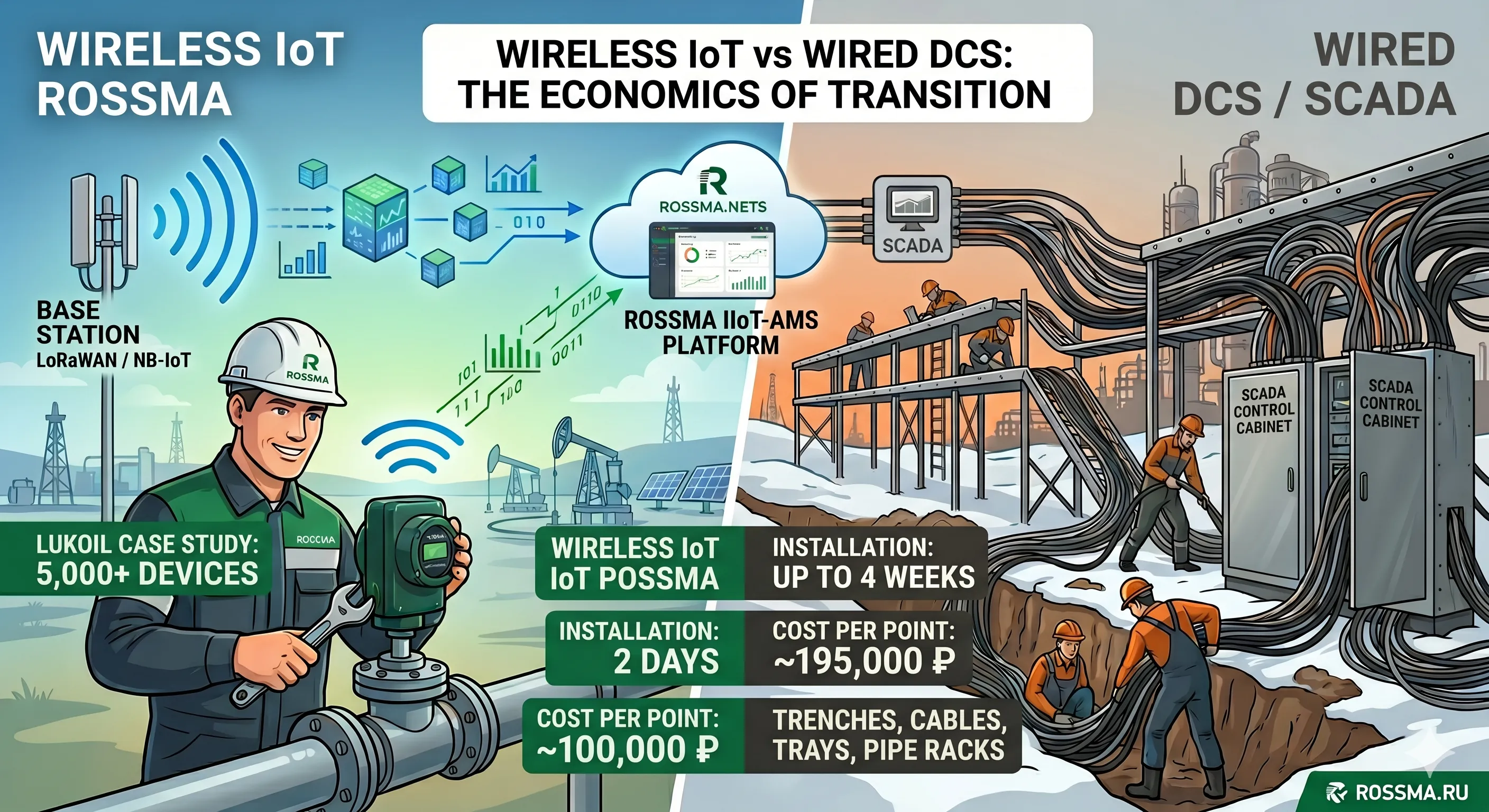
Wired automation β€” cables, trenches, cable trays β€” was for decades the only option for industrial monitoring. But its economics are heavy: 3–6 million RUB per single wellpad, 2–4 weeks of installation, and the inability to scale quickly. Wireless industrial IoT based on LoRaWAN/NB-IoT changes this economics radically β€” but not everywhere and not always. Let us be honest about where the switch delivers a 60–65% cost cut, and where wired SCADA is still justified.

In short: the key figures

  • βˆ’65% CapEx to equip a wellpad (10.5 vs ~30.5 million RUB for 100 points)
  • 2 days vs 4 weeks β€” site installation time
  • 0 RUB for cable, trenches and cable trays
  • 5,000+ ROSSMA devices in a single project (LUKOIL)
  • βˆ’55 Β°C operating temperature, replaceable battery every ~3 years

Why wired ICS is losing ground

Wired industrial control systems rely on 4–20 mA analog signals and HART/Foundation Fieldbus digital protocols. Each sensor is connected to the controller by a twisted pair or coaxial cable. The architecture has worked for decades β€” but it has systemic problems:

  • Cable laying cost β€” 500 RUB/m Γ— 200–500 m to each sensor + trenches, trays, penetrations
  • Installation time β€” 2–4 weeks per wellpad (earthworks, laying, commissioning)
  • Rigidity β€” adding a new monitoring point means a new cable from the sensor to the cabinet
  • Maintenance β€” cable damage (rodents, corrosion, mechanical) requires excavation
  • Far North β€” in permafrost you do not dig: cable is routed along above-ground cable overpasses (steel structures on piles with foundations) β€” a separate, very expensive item

Hidden costs: cable, trenches, maintenance

When estimating a wired system, only the sensor is often counted. But the main costs are in the infrastructure:

Cost item Per point Comment
Sensor (wired) 42,500 RUB Cheaper than wireless, but only ~20% of TCO
Cable (200 m) 100,000 RUB 500 RUB/m Γ— 200 m (average distance)
Trench / tray / overpass 30,000–150,000 RUB In the Far North there is no digging β€” cable runs on overpasses on piles (pricier than trenches)
Installation and commissioning 52,500 RUB Γ—3.5 the wireless installation
TOTAL per point 195,000–345,000 RUB 2–3.5Γ— more expensive than wireless

For an oilfield wellpad with 50–100 points this is 10–27 million RUB on infrastructure alone.

Moreover, a modern cable route at an industrial site is, as a rule, fiber optics, not just copper. That adds a whole layer of equipment for building the optical network that is almost always forgotten at the start:

  • Optical trunk cable + protective conduit/tray
  • Optical splice closures and optical distribution frames (ODF) in cabinets
  • Fiber fusion splicing β€” special tooling (splicer, OTDR reflectometer) and qualified technicians
  • Media converters and interface converters (4–20 mA / RS-485 β†’ Ethernet/fiber) for each group of sensors
  • Industrial managed switches with SFP modules
  • Field RTUs/controllers to digitize analog signals before transmission over fiber

That is another tens to hundreds of thousands of RUB of active equipment per site β€” on top of the cable and earthworks. All of it is counted as a separate “Optical network” line in the 100-point summary below.

Wireless IoT: how it works

The ROSSMA IIoT-AMS platform uses wireless LPWAN technologies to transmit data from sensors to the network server:

  1. A smart device (pressure, temperature, vibration, etc.) measures the parameter, runs local logic and transmits data over the radio channel
  2. A base station (LoRaWAN/Mesh) or an operator network (NB-IoT/LTE) receives the data
  3. ROSSMA.NETS β€” a single network server: all communication standards arrive at one point regardless of technology
  4. ROSSMA.NETS HMI β€” in-house SCADA: visualization, setpoints, alerts

No cables, trenches or trays. Installing one device takes 15–30 minutes (mount, switch on, register in the network). Importantly, ROSSMA devices run on a single proprietary secure protocol on top of any communication standard (LoRaWAN, NB-IoT, LTE, 868 MHz Mesh) β€” the customer is not locked to an operator and can combine technologies on the same site.

Comparison: ROSSMA vs wired SCADA

Parameter ROSSMA (wireless) Wired SCADA
Sensor cost 85,000 RUB 42,500 RUB
Cable per point 0 RUB 100,000 RUB
Installation per point 15,000 RUB 52,500 RUB (Γ—3.5)
Total per point ~100,000 RUB ~195,000 RUB
Site installation time 1–2 days 2–4 weeks
Adding new points Minutes Weeks (new cable)
Cable maintenance None Excavation, replacement
Operation on damage Other devices keep working Cable break = data loss
Autonomy Edge logic, 50,000-record archive Depends on power and link

Why is a wireless sensor twice as expensive as a wired one?

A fair question: 85,000 vs 42,500 RUB. The difference is not markup, but the fact that a ROSSMA wireless device is not a “sensor with a radio module” but an autonomous edge controller: built-in radio, a battery, its own processor running setpoint logic and an archive, and no separate 4–20 mA transmitter or intrinsic-safety barriers. A wired sensor is cheaper “in hardware” but requires 150,000+ RUB of infrastructure around it. The correct comparison is not the sensor price but the cost of the whole point β€” and there wireless is twice as cheap.

7-year TCO: counting total cost of ownership, not CapEx

CapEx is only half the story. Over the operating life, a wired system incurs recurring costs to maintain cable routes, while a wireless one needs only periodic battery replacement. Total cost of ownership of one point over 7 years:

Item (7 years) ROSSMA Wired SCADA
CapEx (whole point) 100,000 RUB 195,000 RUB
Cable/route maintenance 0 RUB ~70,000 RUB (repairs, inspections)
Battery replacement ~6,000 RUB (2 replacements over 7 years) β€”
Downtime from breaks β‰ˆ0 (autonomous buffer) Data loss until repair
TCO over 7 years ~106,000 RUB ~265,000 RUB

The gap widens over time: the longer the operation, the more expensive wired infrastructure becomes. Payback for a pilot is usually within the first year from cable and installation savings.

Where the savings peak: sensitivity to distance

The main driver of savings is the cable run length. The farther the sensor from the cabinet, the more advantageous wireless is. Conversely, on short runs the difference shrinks:

Distance to point Wired (point) ROSSMA (point) Saving
30 m (near the cabinet) ~110,000 RUB ~100,000 RUB ~10% (parity)
100 m ~150,000 RUB ~100,000 RUB ~33%
200 m (typical) ~195,000 RUB ~100,000 RUB ~49%
500 m (remote object) ~330,000 RUB ~100,000 RUB ~70%

Bottom line: on short runs (<50 m) wired connection is competitive on price; from 100 m and for remote objects wireless IoT wins by a wide margin. For distributed fields with kilometers between wellpads there is practically no alternative to wireless.

Autonomous operation on link loss β€” the key differentiator

Most IoT sensors are “dumb” transmitters: no link β€” no data and no control. ROSSMA devices are edge controllers with autonomous logic. On losing the link to the base station the device:

  • Continues measuring on schedule
  • Stores data in a buffer (up to 50,000 records)
  • Monitors setpoints and controls outputs (relays) on its own β€” the process does not stop
  • Automatically transmits the accumulated archive once the link is restored

A wired system on a cable break simply loses data until repair. This is not a “sensor” but distributed automation resilient to communication-channel failures.

Security of wireless transmission

Objection #1 to wireless in industry is “it is insecure”. In practice a properly configured wireless network is no less, and often more, secure than a wired one:

  • End-to-end encryption β€” data is encrypted on the device (AES-128 in LoRaWAN) and decrypted only on the network server; intercepting the radio is useless
  • Private network β€” base stations and ROSSMA.NETS are deployed within the enterprise perimeter, with no public internet exposure
  • Proprietary protocol β€” ROSSMAs own secure protocol rather than an open stack that is easier to attack
  • Device authentication β€” every device is registered in the network by keys; a rogue device will not connect

For comparison: wired Modbus RTU and HART historically transmit data without encryption β€” physical access to the cable gives access to the traffic.

Explosion protection and hazardous-area operation

For oil & gas and petrochemicals, monitoring takes place in explosive zones β€” a mandatory requirement, not an option. ROSSMA devices have a hazardous-area version:

  • Explosion protection Ex d (flameproof enclosure) and intrinsically safe circuits
  • Compliance with TR CU 012/2011 on equipment for explosive atmospheres
  • Compatibility with international ATEX / IECEx schemes for export projects
  • Operating range βˆ’55…+85 Β°C β€” wider than the standard βˆ’40…+85 Β°C, for the Far North

This allows wireless devices to be placed where expensive explosion-proof wired instrumentation with intrinsic-safety barriers used to be required.

When wired ICS is still justified

Wireless IoT is not a silver bullet. Honestly about where wired remains the standard:

  • Fast control loops β€” PID control with tens-of-milliseconds response (e.g. anti-surge compressor control) requires deterministic wired communication
  • Certified ESD/SIS systems of SIL 2–3 β€” emergency shutdown functions are usually executed over wired safety loops
  • Very short runs (<30–50 m) next to the cabinet β€” savings are minimal
  • Existing healthy cable infrastructure β€” there is no point replacing working wiring; wireless pays off on new and revamped sites

The optimal strategy is a hybrid: keep critical fast loops and ESD wired, and move mass monitoring, telemetry and remote objects to wireless IoT. That is exactly how real ROSSMA deployments are built.

Calculation: 100 points on a wellpad

Full cost of equipping a typical oilfield wellpad:

Item ROSSMA (100 points) Wired SCADA (100 points)
Sensors 8,500,000 RUB 4,250,000 RUB
Cable routes (trenches or overpasses on piles) 0 RUB 13,000,000 RUB
Optical network: splice closures, ODF, fiber splicing, media converters, industrial SFP switches, field RTUs β€” 4,500,000 RUB
Base stations 360,000 RUB (2 pcs.) β€”
Control cabinet β€” 2,000,000 RUB
Installation 1,500,000 RUB 5,250,000 RUB
SCADA platform 150,000 RUB 1,500,000 RUB
TOTAL 10,510,000 RUB 30,500,000 RUB
Saving 19,990,000 RUB (65%)

Installation time drops from 4 weeks to 2 days. Calculate the saving for your site.

Case: LUKOIL β€” 5,000+ ROSSMA devices

The largest ROSSMA deployment is wellpad monitoring for LUKOIL at oilfields. More than 5,000 wireless pressure and temperature devices on wells, metering units, pipelines and underwater crossings.

  • Winter temperatures down to βˆ’50 Β°C (ROSSMA devices work down to βˆ’55 Β°C)
  • Distances between wellpads of kilometers (LoRaWAN: up to 15 km)
  • Replacing wired telemetry without halting production β€” in stages, in parallel with the existing system
  • Integration with the existing SCADA over Modbus RTU β€” without replacing the upper level
  • Result: a point installed in minutes instead of weeks; no earthworks, cable overpasses or breaks on distributed Far North objects

Case: T Plus β€” district heating monitoring

Wireless IoT works not only in oil & gas. In district heating for T Plus, ROSSMA devices monitor heat networks: heat meters over Modbus, 1-Wire temperature sensors, pulse counters and leak detectors.

  • Urban infrastructure β€” running cable along streets and basements is prohibitively expensive and slow
  • Wireless devices are installed in heat points and chambers in minutes, without opening up routes
  • Early leak detection reduces coolant losses and accident rates

In total, ROSSMA has 12+ major deployments and 10,000+ devices across oil & gas, petrochemicals and utilities (LUKOIL, Gazprom Neft, Tatneft, SIBUR, Surgutneftegas and others).

How to start the switch to wireless monitoring

  1. Pick a pilot object β€” a wellpad, a pump station, a pipeline section
  2. Define the parameters β€” pressure, temperature, level, vibration
  3. Plan the network β€” use the LPWAN Network Planner to calculate coverage
  4. Install the pilot β€” 10–50 devices in parallel with the wired system
  5. Evaluate the result β€” compare data, economics, convenience
  6. Scale β€” phased migration to the remaining objects

Frequently asked questions

How reliable is the wireless channel at an industrial site?

LoRaWAN is resilient to interference and metal structures thanks to narrowband modulation and a large link margin (up to 15 km line-of-sight, hundreds of meters in dense layouts). On a brief link loss ROSSMA devices keep working autonomously and resend the archive on restoration β€” data is not lost.

How often do batteries need replacing?

A replaceable battery lasts about 3 years (depending on polling frequency and conditions). Replacement is done in minutes during routine maintenance, costs a few thousand RUB and requires no excavation or process stop.

Is it secure from a cybersecurity standpoint?

Yes. Data is encrypted on the device (AES-128) and decrypted only on the network server, the network runs in a private enterprise perimeter with no internet exposure, and devices authenticate by keys. Wired Modbus/HART, by contrast, often transmit data without encryption.

Can it integrate with our existing SCADA?

Yes. ROSSMA.NETS exposes data over Modbus RTU/TCP and OPC, so wireless devices connect to the existing upper level without replacing it β€” as in the LUKOIL project.

Is it suitable for hazardous areas?

Yes. ROSSMA devices are made in an explosion-proof Ex d version per TR CU 012/2011 (compatible with ATEX/IECEx) and operate in the βˆ’55…+85 Β°C range.

Is it better to replace everything at once or migrate in stages?

In stages. Start with a 10–50-point pilot in parallel with the wired system, compare economics and data, then scale. Critical fast loops and ESD can stay wired (hybrid scheme).

ROSSMA products to replace wired systems

Read also

Import Substitution in Industrial IoT: Market Overview 2026

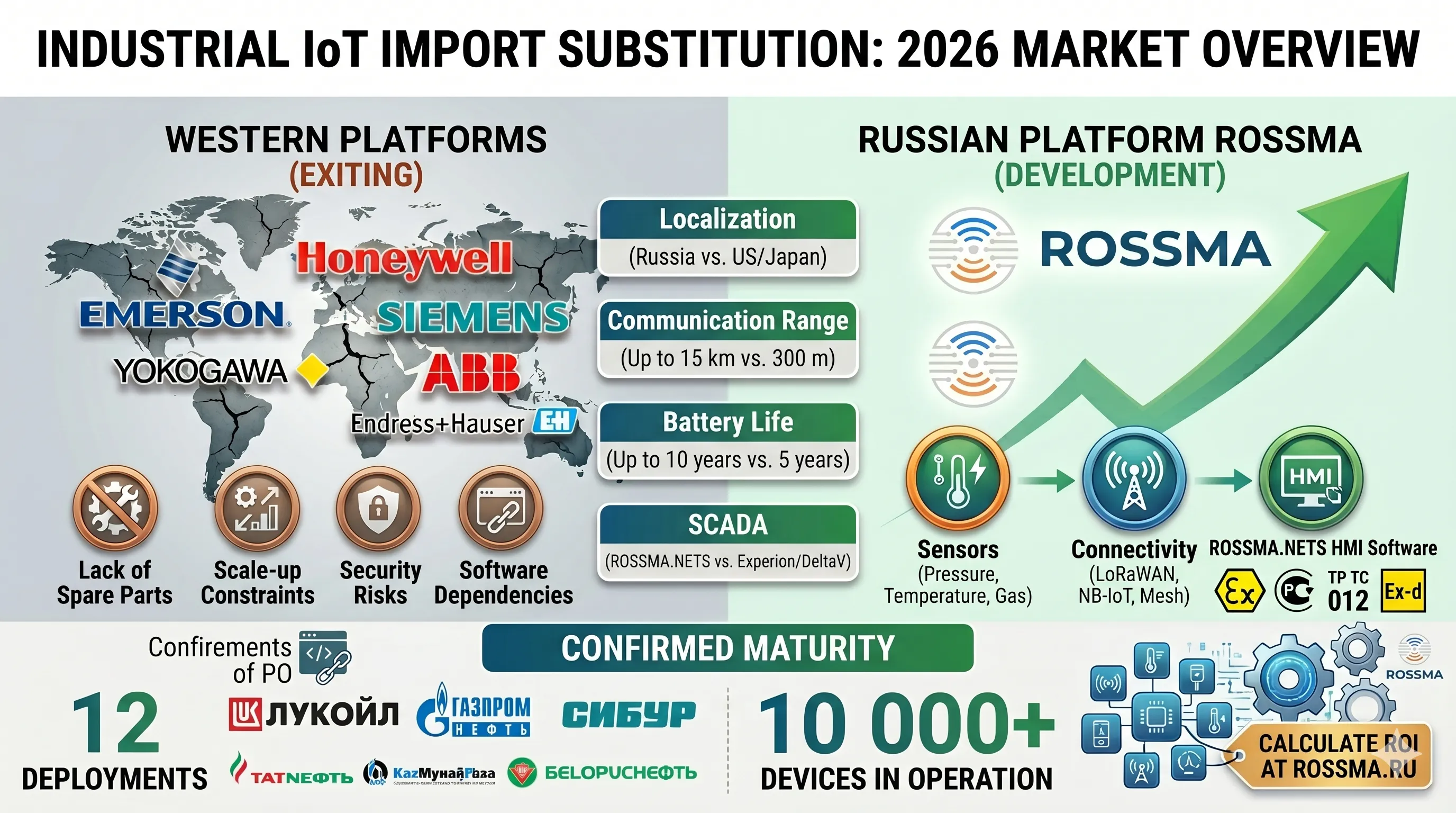
Industrial Internet of Things (IIoT) has become one of the critical fronts in Russia’s import substitution strategy. After major Western vendors β€” Emerson, Honeywell, Yokogawa, Siemens β€” ceased or restricted operations in Russia, enterprises in oil & gas, utilities, and manufacturing faced a critical problem: equipment is running, but spare parts are unavailable, technical support has been discontinued, and software licenses cannot be renewed. This article examines the current market landscape and compares the Russian ROSSMA platform against Western alternatives.

Why Industrial IoT Is a Key Front of Import Substitution

Automated Process Control Systems (APCS) are the nervous system of any industrial enterprise. Pressure, temperature, level, gas, and vibration sensors continuously collect data that drives equipment management decisions.

Until 2022, the Russian industrial wireless sensor market was almost entirely dependent on imports:

  • Emerson (Rosemount, Fisher) β€” pressure and temperature transmitters, WirelessHART, DeltaV DCS
  • Honeywell β€” OneWireless, Experion PKS, safety and gas detection
  • Yokogawa β€” ISA100 Wireless, CENTUM VP, analytical instruments
  • Siemens β€” SITRANS, PCS 7, industrial networks
  • ABB β€” sensors, DCS, variable frequency drives
  • Endress+Hauser β€” level, flow, and analytical instruments

Dependence on these vendors creates risks not only in new equipment procurement but also in servicing already installed systems: firmware cannot be updated, calibration requires proprietary software, and spare parts are under sanctions.

Exit of Emerson, Honeywell, Yokogawa: What Happened

In 2022–2023, the world’s largest industrial automation manufacturers ceased or significantly restricted their operations in Russia:

  • Emerson β€” stopped deliveries, closed Russian office. DeltaV/AMS service contracts not renewed
  • Honeywell β€” suspended sales and technical support. Experion PKS licenses not updated
  • Yokogawa β€” restricted deliveries, technical support reduced to minimum
  • Siemens β€” complete withdrawal from Russia, including industrial automation

For enterprises operating thousands of sensors from these manufacturers, this means: when equipment fails, replacement is impossible, and repairs rely on “grey” imports at multiples of the original price β€” with no warranty.

Risks of Dependence on Western Equipment

Operating Western equipment under current conditions carries specific risks:

  • No spare parts β€” average industrial sensor lifetime is 10–15 years, but without spares, failures are critical
  • Cannot scale β€” impossible to purchase additional sensors for new facilities
  • Software dependency β€” DeltaV, Experion, CENTUM licenses require renewal
  • Security β€” firmware updates unavailable, vulnerabilities remain unpatched
  • CII compliance β€” critical information infrastructure facilities must transition to domestic software

Russian Alternatives: ROSSMA as a Full-Cycle Platform

ROSSMA is a Russian manufacturer of industrial IoT equipment offering a full cycle: from wireless sensors to a cloud SCADA platform. Unlike attempts to assemble “import substitution” from disparate components of different vendors, ROSSMA provides a unified ecosystem:

  • Sensors β€” pressure, temperature, vibration, gas analysis, level, current (31 models)
  • Connectivity β€” LoRaWAN, NB-IoT, LTE, 868 MHz Mesh β€” all in one protocol
  • Infrastructure β€” base stations, Modbus gateways, control relays
  • Software β€” ROSSMA.NETS HMI (included in the Russian Software Registry No. 2024688076)
  • Solutions β€” WellPAD for well pads, Pipeline Leak Detector

Comparison Table: ROSSMA vs Western Platforms

Parameter ROSSMA Emerson Honeywell Yokogawa
Manufacturing Russia USA USA Japan
Russian SW Registry βœ“ (No. 2024688076) β€” β€” β€”
Wireless protocol LoRaWAN / NB-IoT / Mesh WirelessHART OneWireless (ISA100) ISA100
Communication range 5–15 km 100–250 m 200–300 m 200–300 m
Battery life Up to 10 years 3–5 years 3–5 years 3–5 years
Temperature range βˆ’55…+85 Β°C βˆ’40…+85 Β°C βˆ’40…+85 Β°C βˆ’40…+85 Β°C
Edge computing βœ“ (on-device setpoints) β€” β€” β€”
SCADA included ROSSMA.NETS HMI DeltaV ($$$) Experion ($$$) CENTUM ($$$)
Spare parts No restrictions Sanctions Sanctions Limited
Tech support in Russia 24/7, Russian Discontinued Discontinued Limited

Russian Software Registry and Certifications

The ROSSMA IIOT-NETS software platform is listed in the Unified Russian Software Registry (registration No. 2024688076). This ensures:

  • Compliance with government procurement and CII facility requirements
  • No dependency on foreign software licenses
  • Support for Astra Linux and other Russian operating systems

ROSSMA equipment is certified to explosion-proof standards:

  • ATEX β€” European standard for hazardous areas
  • TR CU 012/2011 β€” Customs Union technical regulation
  • IECEx β€” international certification
  • Protection types: Ex d (flameproof enclosure), Ex ia (intrinsic safety), Ex e (increased safety)

12 Deployments: From LUKOIL to KazMunayGas

ROSSMA is not a startup with a prototype β€” it is a manufacturer with a proven base of over 10,000 devices in operation at major enterprises:

  • LUKOIL β€” 5,000+ devices (Komi Republic, Perm Krai)
  • Irkutsk Oil Company β€” 1,000+ devices (drilling, field operations)
  • Gazprom Neft β€” well pad monitoring (KhMAO region)
  • SIBUR β€” ZapSibNefteKhim, IIoT in hazardous zones
  • Tatneft β€” “Digital Oilfield” program
  • RussNeft (PJSC) β€” pipeline leak detection
  • T Plus (TGC) β€” district heating networks (Perm, Yekaterinburg)
  • TOT (De-Kastri) β€” industrial facility monitoring
  • BelorusNeft β€” export project (Belarus)
  • KazMunayGas β€” export project (Kazakhstan)
  • UzbekNefteGaz β€” export project (Uzbekistan)

These deployments prove the platform’s maturity in real industrial conditions β€” from Arctic oilfields in Komi to the steppes of Uzbekistan.

How to Migrate to ROSSMA

Transitioning from Western equipment to ROSSMA does not require production shutdown. A typical migration program:

  1. Audit β€” inventory of existing equipment, identification of priority areas
  2. Pilot β€” installation of 10–50 ROSSMA sensors in parallel with the existing system
  3. Integration β€” connection to existing SCADA via Modbus/HART or transition to ROSSMA.NETS
  4. Scaling β€” phased replacement as Western equipment reaches end-of-life

With native Modbus RTU and HART protocol support, ROSSMA sensors integrate with existing infrastructure without replacing the entire system. Calculate your transition savings using our ROI calculator.

Related Products and Solutions

LPWAN Networks for Industry: Architecture, Deployment and Scaling

Why LPWAN, Not Wi-Fi, Cellular or WirelessHART

Requirement Wi-Fi Cellular WirelessHART LPWAN (LoRaWAN)
Range 50–100 m 1–5 km 100–250 m Up to 15 km
Battery life Hours Months 3–5 years Up to 10 years
Subscription No Yes (SIM) No No
Own infrastructure No No No (HART GW) Yes
Basement/manhole penetration Poor Average Average Excellent
Interference resistance Low Average High (FHSS) High (CSS)
Encryption WPA2/3 Operator AES-128 AES-128 (two-level)

Industrial LPWAN Network Architecture

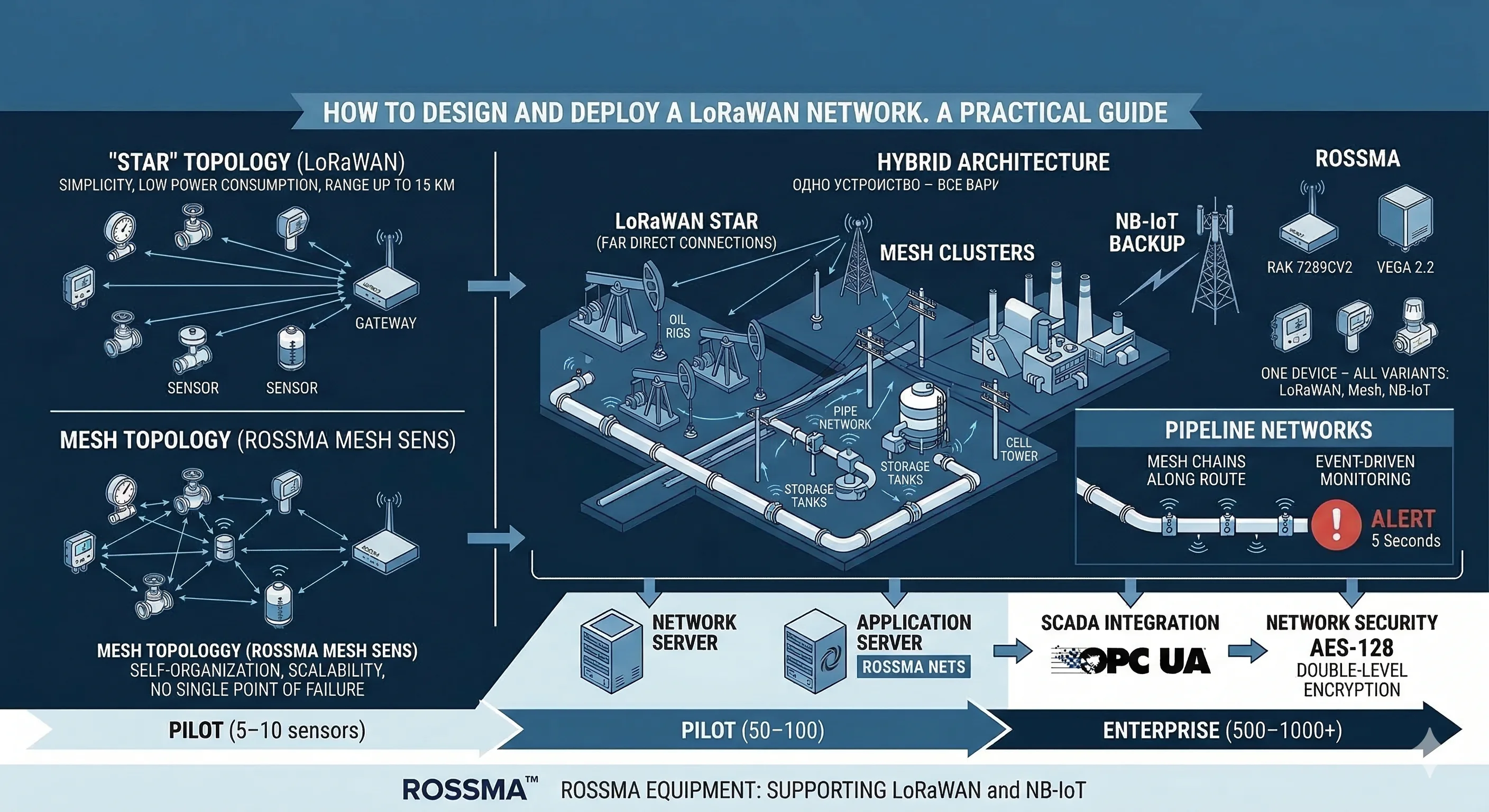
Star Topology β€” Classic LoRaWAN

End devices β†’ Base stations β†’ Network Server β†’ Application Server (ROSSMA NETS). Up to 1000 sensors per base station, range up to 15 km.

Mesh Topology β€” ROSSMA MeshSens

Each node retransmits neighbor data. Self-organizing, no single point of failure, scales as nodes are added. Ideal for dense urban areas and utility infrastructure.

Hybrid Architecture

LoRaWAN star for remote sensors + Mesh clusters for dense groups + NB-IoT backup. ROSSMA equipment supports all three β€” switch via configurator.

Extended Pipelines: Mesh + Event-Driven Monitoring

Mesh Coverage Along Pipeline Routes

Linear Mesh chain of sensors every 0.5–2 km along pipeline. Each node relays to neighbors. Covers pipelines of any length without multiple base stations. Solar-powered for remote sections.

Event-Driven Mode

ROSSMA IIOT-AMS P-METER measures pressure every 5 seconds. Normal = sleep (zero transmission). Threshold exceeded = instant alert. Over 1,000,000 measurements per 14 Ah battery.

ROSSMA Pipeline Leak Detector

ROSSMA Pipeline Leak Detector β€” automatic leak detection by pressure patterns, section-level localization, Telegram/email alerts, SCADA integration via OPC UA/REST API.

ROSSMA IIOT-WellPAD β€” Well Pad Solution

ROSSMA IIOT-WellPAD β€” complete well pad monitoring: field sensors (P-METER, 1-Wire Ex, VPM, Tilt Counter Ex) β†’ LoRaWAN base station β†’ Edge PC (Astra Linux + Kaspersky) β†’ SCADA/MES via VPN.

Parameter Wired APCS ROSSMA WellPAD
Cost per pad –60K –15K
Installation 2–4 weeks 1–2 days
Earthworks Yes No
ROI 3–5 years 12–18 months

Base Station Selection

Parameter VEGA 2.2 RAK 7289CV2
LoRa channels 8 Up to 16
Protection IP65 IP67/NEMA-6
Connectivity Ethernet Ethernet, Wi-Fi, 4G

Coverage Planning

Use ROSSMA LPWAN Network Planner for terrain-aware coverage calculation.

Network Security

AES-128 two-level encryption (NwkSKey + AppSKey), unique keys per device (OTAA), frame counters against replay attacks, private network.

Conclusions

Industrial LPWAN on LoRaWAN: independence, AES-128 security, star/Mesh/hybrid flexibility, 10+ year battery, pilot in 1–2 weeks.

Ready to design? Use ROSSMA Network Planner or contact us.

Utility Automation: Wireless Monitoring of Building Systems

The Problem: Manual Control, Resource Losses and Emergencies

Utility companies, water utilities and heat supply organizations face systemic problems daily that cannot be solved without automation.

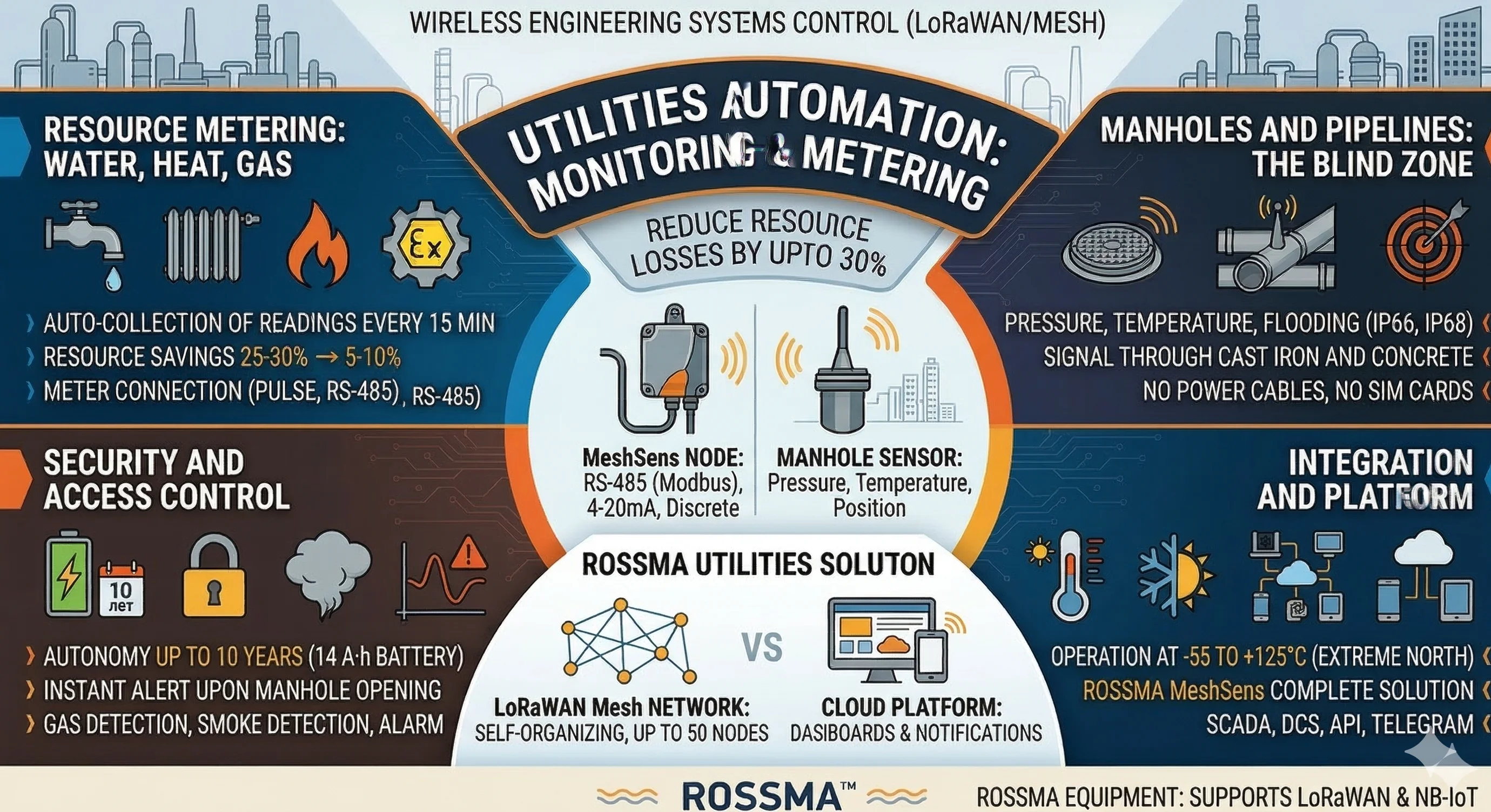
Metering and Resource Accounting

  • Manual rounds β€” inspectors visit basements, heat substations, metering nodes, manholes, recording readings by hand
  • Resource losses up to 25–30% β€” discrepancy between building-level and apartment-level meters. Without real-time data, leaks go undetected for weeks
  • Outdated data β€” readings collected once a month, decisions based on month-old information

Pipelines and Manholes β€” the “Blind Zone”

Underground utilities are the most vulnerable part of city infrastructure. Water and heat pipelines run through manholes and collectors where:

  • No connectivity β€” concrete walls, cast iron covers, soil block cellular signal. NB-IoT and GSM don’t work
  • No electricity β€” running a power cable to a manhole costs from $1,000 and requires permits
  • No pressure monitoring β€” pressure drop indicates a leak, but without sensors it’s only discovered when water surfaces
  • No temperature control β€” pipe freezing at -40Β°C in winter, heat main overheating in summer
  • Manhole flooding β€” groundwater, pipe bursts. Flooded manholes mean equipment corrosion

Manhole Cover Access Control

  • Safety hazard β€” pedestrians and vehicles falling into open manholes, lawsuits
  • Theft β€” cast iron covers sold as scrap metal
  • Vandalism β€” unauthorized access, illegal pipe taps

Safety

  • Gas leaks β€” in basements, boiler rooms, gas distribution points
  • Smoke β€” fires in electrical rooms, basements, technical premises
  • No alerts β€” dispatcher learns from residents, not from the system

Solution: Wireless IoT Monitoring

Wireless IoT systems automatically collect data from meters and sensors every 5–60 minutes. Data flows to a cloud platform where the dispatcher sees all facilities on one screen.

What Can Be Monitored

Pipelines in Manholes

  • Pipeline pressure β€” ROSSMA P-METER installed directly in manholes. Β±0.2% accuracy, background monitoring every 5 seconds
  • Heat main temperature β€” ROSSMA 1-Wire with DS18B20 sensors (-55…+125Β°C). Up to 5 measurement points per device
  • Manhole flooding β€” ROSSMA Leak Detector at manhole bottom. Instant alert + audible siren
  • Valve position β€” ROSSMA Dry Contact VPM measures valve opening percentage (0–100%)

Manhole and Cabinet Control

  • Cover opening β€” ROSSMA Dry Contact detects opening/closing, instant alert to dispatcher
  • Theft protection β€” ROSSMA ESD detects vibration, impact, tilt >15Β°

Safety

Economic Impact

Metric Before After IoT
Meter reading Monthly (manual) Every 15 min (auto)
Leak detection Days–weeks Seconds (instant alert)
Resource losses 25–30% 5–10%
Manhole control Quarterly inspection Continuous
Communication cost SIM per device $0 (own LoRaWAN network)
ROI β€” 6–12 months

Conclusions

Utility automation with ROSSMA IoT pays for itself in 6–12 months. Wireless sensors work in manholes, basements, underground β€” where cellular networks fail.

Need a cost estimate? Contact us or use the AI Equipment Selector.

How to Choose a Pressure Sensor for Oil and Gas Industry

Why Choosing a Pressure Sensor Is a Critical Task

At oil and gas facilities, a pressure sensor is not just an instrument β€” it is a safety system element. Incorrect readings or loss of communication can lead to pipeline accidents, equipment damage, or environmental disasters. Selection criteria for oil and gas are fundamentally different from standard industrial applications.

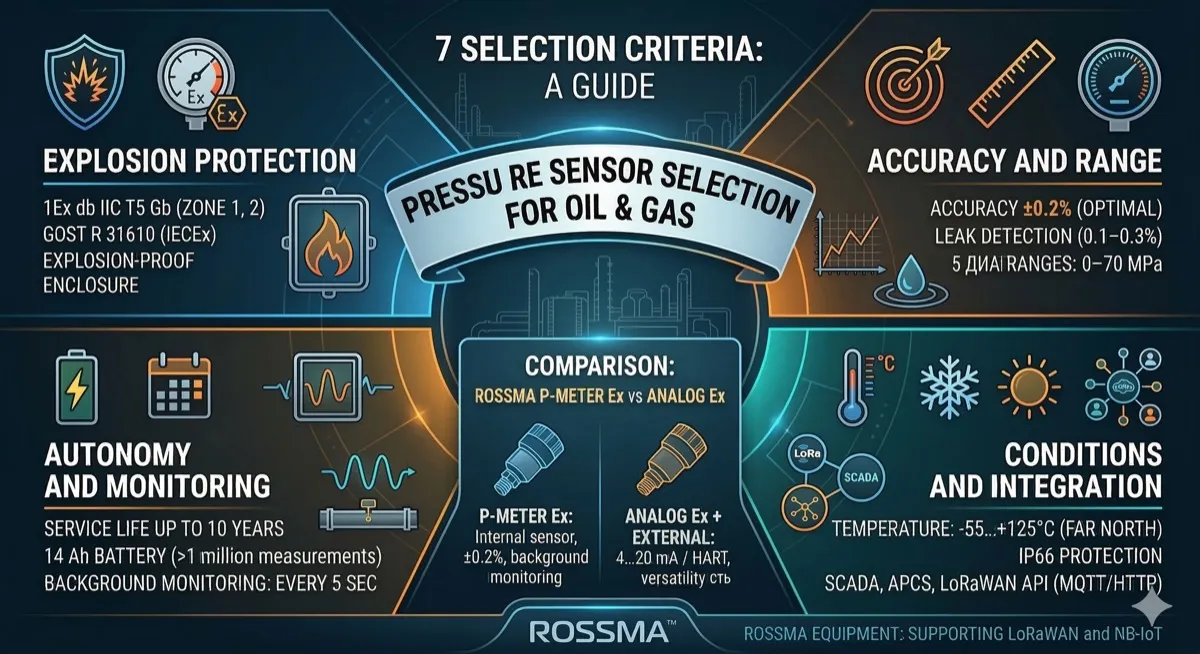
7 Criteria for Choosing a Pressure Sensor for Oil and Gas

1. Explosion Protection β€” Mandatory Requirement

Oil and gas facilities are classified as Zone 1 and Zone 2 hazardous areas. All equipment must be certified to IECEx / GOST R 31610.

  • Type “d” (flameproof enclosure) β€” most reliable for Zone 1. Marking: 1Ex db IIC T5 Gb
  • Temperature class T5 (up to 100Β°C) is preferable to T4 β€” lower surface temperature
  • Group IIC β€” strictest, includes hydrogen (all oil and gas environments)

ROSSMA P-METER Ex carries marking 1Ex db IIC T5 Gb X β€” flameproof enclosure, group IIC, temperature class T5.

2. Accuracy Class β€” Not All 0.5% Are Equal

In oil and gas, pressure measurement accuracy directly impacts leak detection, production optimization, and safety.

Accuracy Error Oil & Gas Suitability
1.5% Β±1.5% Insufficient for most tasks
0.5% Β±0.5% Minimum acceptable
0.2% Β±0.2% Optimal β€” leak detection, precise metering

ROSSMA P-METER Ex provides Β±0.2% accuracy β€” 7.5Γ— more precise than typical 1.5% solutions.

3. Measurement Range

Available ranges: 0–7 / 0–10 / 0–20 / 0–35 / 0–70 MPa β€” covering all typical oil and gas applications from flowlines to high-pressure gas pipelines.

4. Battery Life β€” Wired vs Wireless

Cable installation in explosion-proof conduit costs from ,000/km and takes months of planning. Wireless sensors with autonomous power solve this problem.

ROSSMA P-METER Ex with 14 Ah battery provides over 1,000,000 measurements. Background pressure monitoring every 5 seconds with virtually zero power consumption β€” data transmitted only when thresholds are exceeded. Real battery life: up to 10 years.

5. Monitoring Mode β€” The Key Differentiator

Background monitoring: sensor wakes every 5 seconds, compares pressure to thresholds. Normal = sleep without transmission. Threshold exceeded = instant alert. Continuous monitoring with minimal battery drain.

6. Temperature Range

Parameter ROSSMA P-METER Ex Typical Competitors
Operating temperature -55…+80Β°C -40…+60Β°C
Media temperature -40…+125Β°C -20…+85Β°C
Protection IP66 IP65

7. Integration with SCADA and Cloud

LoRaWAN Network Server β†’ MQTT/HTTP API β†’ SCADA, ROSSMA NETS, ThingsBoard, Chirpstack.

P-METER Ex vs ANALOG Ex: Which to Choose?

Parameter P-METER Ex ANALOG Ex + external sensor
Accuracy Β±0.2% Depends on sensor (0.5–1.5%)
Background monitoring Yes (every 5 sec) No
Battery life >1,000,000 measurements ~40,000 packets
Flexibility Pressure only Any 4…20 mA sensor
Explosion protection 1Ex db IIC T5 1Ex e IIC T4

Conclusions

7 key criteria for oil and gas pressure sensors: explosion protection (type “d”, IIC, T5), accuracy (0.2%), range, battery life (10 years), background monitoring, temperature range (-55Β°C), and SCADA integration.

Need help choosing? Use AI Equipment Selector or contact us.

LoRaWAN vs NB-IoT: Which Technology to Choose for Industrial IoT

Introduction

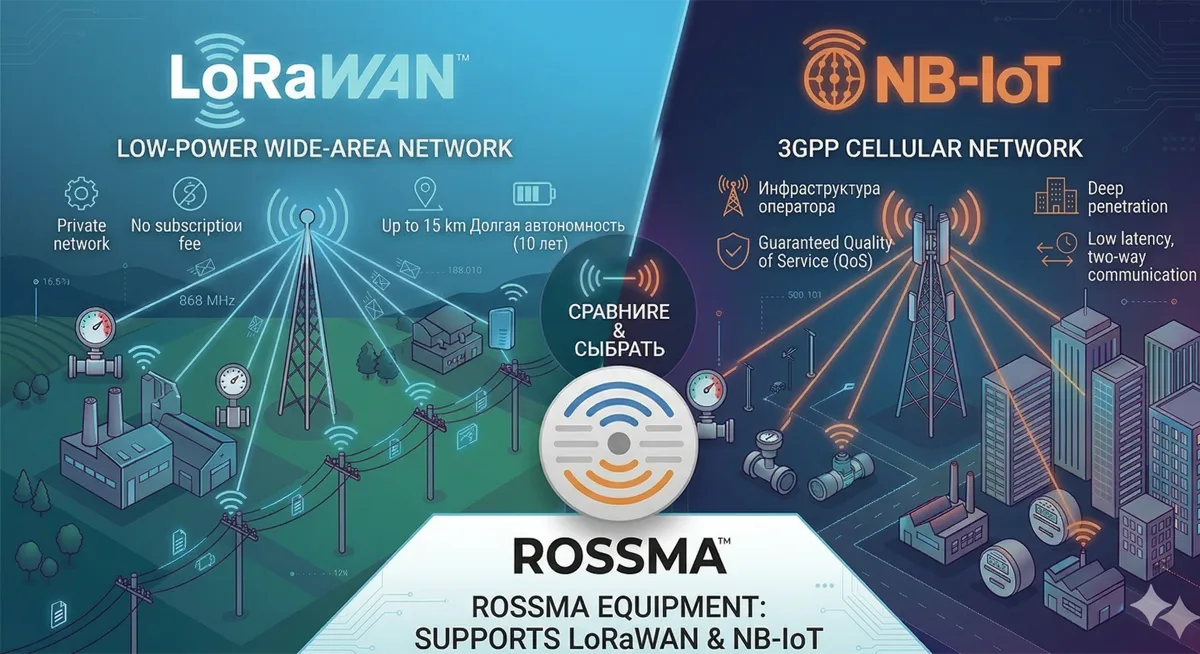
When choosing wireless technology for industrial IoT, engineers face a key question: LoRaWAN or NB-IoT? Both technologies belong to the LPWAN (Low Power Wide Area Network) class and provide long-range data transmission with minimal power consumption. However, there are fundamental differences between them that are critically important when selecting a solution for a specific facility.

LoRaWAN Technology

LoRaWAN (Long Range Wide Area Network) is an open protocol developed by the LoRa Alliance. It operates in unlicensed frequency bands (868 MHz in Europe/Russia, 915 MHz in Americas).

Key Advantages of LoRaWAN

Data Security β€” AES-128 Encryption

LoRaWAN provides two-level data protection: network-level encryption (NwkSKey) and application-level encryption (AppSKey) using the AES-128 algorithm. This means even the network operator cannot access user data β€” it is encrypted with a separate key. Each device receives a unique key pair upon activation, preventing mass compromise.

Superior Signal Penetration

Low transmission power (up to 25 mW) is compensated by Spread Spectrum modulation technology (LoRa CSS) β€” interference resistance down to -20 dB below noise level. Thanks to this, LoRaWAN signal reliably penetrates where NB-IoT loses connection:

  • Manholes and collectors β€” reinforced concrete walls and covers are not an obstacle
  • Basements and underground floors β€” stable communication through multiple floors of concrete
  • Underground utilities β€” data transmission from underground at depths up to 1-2 meters
  • Industrial facilities β€” metal structures and equipment create a shielding effect that LoRaWAN overcomes

High Interference Resistance

Chirp Spread Spectrum (CSS) technology at the core of LoRa provides exceptional interference resistance. The signal is spread across a wide frequency band, making it resistant to narrowband interference from industrial equipment, electric motors, frequency converters, and other electrical equipment on site. In industrial environments with high levels of electromagnetic interference, this is a critical advantage over NB-IoT.

Other advantages:

  • Private network β€” full infrastructure control, independence from telecom operators
  • No subscription fees β€” zero communication costs after deployment
  • Range up to 15 km β€” line of sight, 3-5 km in urban areas
  • Battery life up to 10 years β€” 14 Ah battery provides over 1,000,000 measurements
  • Works without cellular coverage β€” at remote fields, forests, and isolated sites

NB-IoT Technology

NB-IoT (Narrowband IoT) is a 3GPP standard that uses existing cellular operator infrastructure. It operates in licensed spectrum.

NB-IoT advantages:

  • Ready infrastructure β€” no need to deploy your own base stations
  • Guaranteed quality of service (QoS) β€” operator standard
  • Bidirectional communication with low latency β€” suitable for control commands

NB-IoT limitations:

  • Operator dependency β€” no coverage = no communication
  • Subscription fee per SIM card
  • Worse signal penetration in difficult conditions (manholes, underground)
  • Higher power consumption β€” battery drains faster
  • Sensitivity to industrial electromagnetic interference

Comparison for Industrial Applications

Parameter LoRaWAN NB-IoT
Encryption AES-128 (two-level) Standard LTE
Basement/manhole penetration Excellent Average
Underground operation Yes (up to 1-2 m) Difficult
Interference resistance High (CSS) Average
Range Up to 15 km Up to 10 km
Battery (14 Ah) Up to 10 years Up to 5 years
Subscription fee None Yes
Own infrastructure Yes No (operator)
Deployment Base station needed Ready immediately

For remote oil and gas facilities, underground utility infrastructure, and industrial sites with high interference levels β€” LoRaWAN is the only viable solution. NB-IoT may be justified in urban conditions with guaranteed cellular coverage and real-time bidirectional communication needs.

ROSSMA equipment supports both technologies β€” LoRaWAN and NB-IoT. This allows choosing the optimal option for a specific site or using a hybrid approach.

Conclusions

For most industrial applications, we recommend LoRaWAN as the primary technology due to:

  • Two-level AES-128 encryption
  • Superior penetration (manholes, basements, underground)
  • High interference resistance in industrial environments
  • No subscription fees
  • Sensor battery life up to 10 years

NB-IoT remains a backup option for sites with reliable cellular coverage. ROSSMA equipment works with both technologies without replacing sensors β€” simply switch the transmission mode.