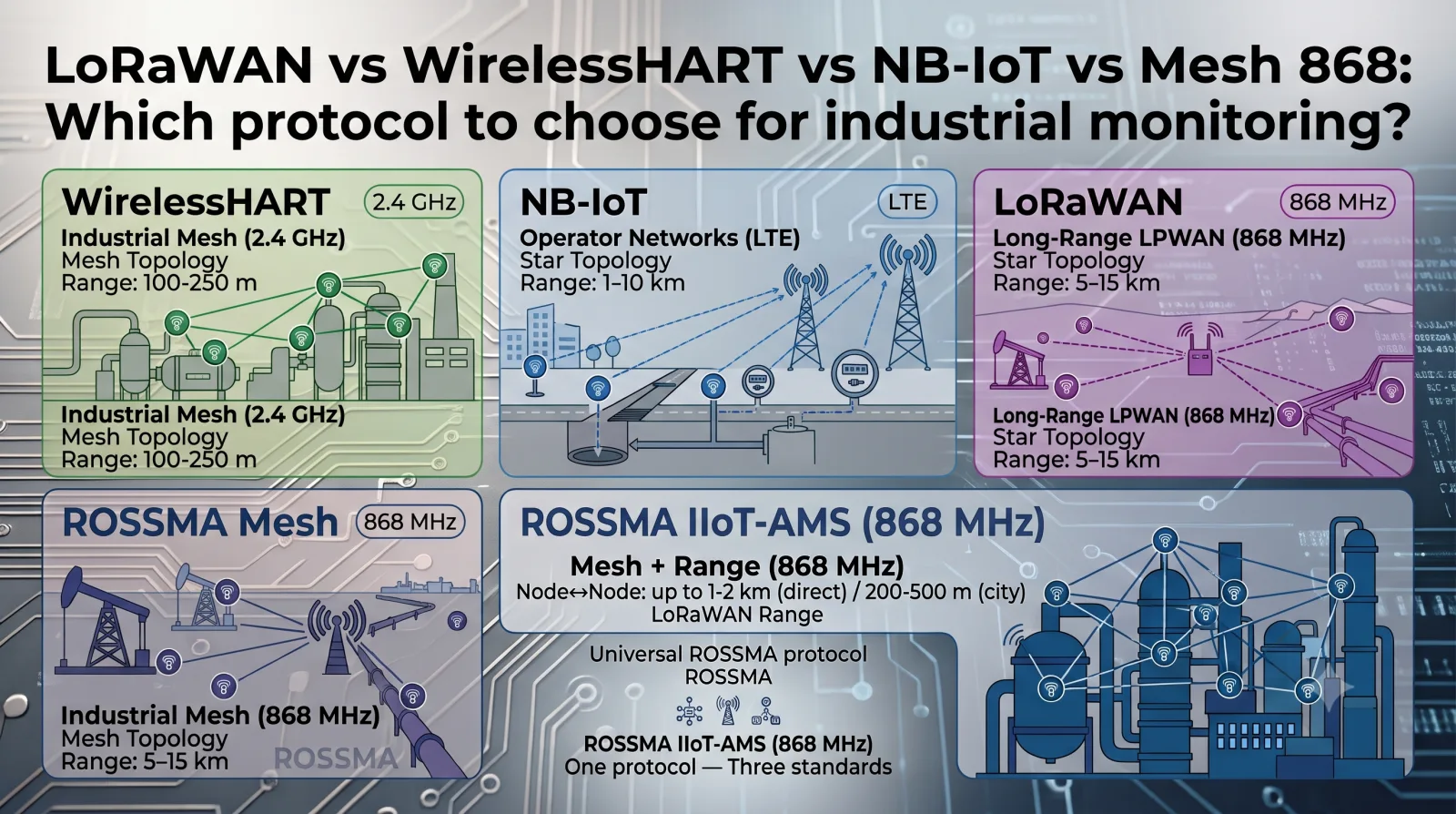
Choosing a wireless communication protocol is one of the first and most critical decisions when designing an industrial monitoring system. WirelessHART, LoRaWAN, and NB-IoT are the three main options, each with its own philosophy, limitations, and economics. Separately, there is ROSSMA’s own mesh network at 868 MHz. This article examines the technical differences and provides practical recommendations for making the choice.
Three Protocols — Three Approaches to Industrial IoT
All three protocols solve the same problem — wireless data transmission from sensors to a collection platform. But they do it in fundamentally different ways:
- WirelessHART — industrial mesh protocol developed by the HART Communication Foundation. Focus on compatibility with existing HART instruments
- LoRaWAN — LPWAN protocol with an open standard (LoRa Alliance). Focus on range and energy efficiency
- NB-IoT — 3GPP standard, operating through cellular operator infrastructure. Focus on coverage without own infrastructure
WirelessHART: Industrial Standard with Limitations
WirelessHART (IEC 62591) operates at 2.4 GHz and uses mesh topology: each node can relay data from neighboring nodes. Key characteristics:
- Frequency: 2.4 GHz (ISM, unlicensed)
- Range: 100–250 m between nodes
- Topology: Mesh (self-organizing)
- Max nodes: 100 per gateway
- Battery: 3–5 years (active relay consumes energy)
- Throughput: 250 kbps (channel), ~1 kbps per node
Advantages: mesh reliability (multiple routes), backward compatibility with wired HART, standard maturity (since 2007).
Limitations: short range (2.4 GHz poor metal penetration), 100 node limit, high cost (Emerson/ABB ecosystem), limited autonomy due to mesh relay.
NB-IoT: Operator Infrastructure for IoT
NB-IoT (Narrowband IoT) is a 3GPP standard using cellular operator infrastructure (MTS, MegaFon, Beeline, Rostelecom). Characteristics:
- Frequency: licensed LTE bands (800/900 MHz)
- Range: 1–10 km (operator-dependent)
- Topology: Star (device → operator base station)
- Throughput: up to 50 kbps (downlink), up to 20 kbps (uplink)
- Battery: 5–10 years (depends on transmission frequency)
- Monthly fee: 300 ₽/mo per SIM card
Advantages: no own infrastructure needed, coverage in cities and along highways, licensed spectrum (no interference).
Limitations: operator dependency (vendor lock-in), per-device monthly fee, no coverage in remote areas (oilfields, tundra), latency can be unpredictable.
Related standards: the 3GPP family also includes LTE-M (higher throughput and mobility support than NB-IoT) and the increasingly popular 5G RedCap — a “lightweight” 5G for IoT devices. In Russia, operators have deployed them less widely than NB-IoT so far, but this is exactly the direction in which operator LPWAN networks are evolving — worth considering for long-term projects.
LoRaWAN: Balancing Range, Autonomy, and Cost
LoRaWAN (Long Range Wide Area Network) is an open standard from the LoRa Alliance using sub-GHz frequencies. Characteristics:
- Frequency: 868 MHz (RU/EU, unlicensed ISM)
- Range: 5–15 km (open terrain), 2–5 km (urban)
- Topology: Star (device → base station)
- Max nodes: 1,000+ per base station
- Battery: up to 10 years (no relay, low power consumption)
- Throughput: up to 50 kbps
- Monthly fee: 0 ₽ (own infrastructure)
Advantages: maximum range among the three protocols, 10-year autonomy, thousands of devices per BS, open standard (no vendor lock-in), sub-GHz better wall and metal penetration.
Limitations: own base station required, limited throughput (not for video/audio), ISM band (possible interference in cities).
Comparison Table: Protocols
The fourth column is ROSSMA’s own mesh network at 868 MHz, built on top of LoRaWAN infrastructure (more details in the section below).
| Parameter | LoRaWAN | WirelessHART | NB-IoT | Mesh 868 (ROSSMA) |
|---|---|---|---|---|
| Frequency | 868 MHz (unlicensed) | 2.4 GHz (unlicensed) | LTE bands (licensed) | 868 MHz (unlicensed) |
| Range | 5–15 km | 100–250 m | 1–10 km | up to 1–2 km (line of sight) / 200–500 m (dense) |
| Topology | Star | Mesh | Star (operator) | Mesh (nodes + base stations, BS-to-BS) |
| Nodes per BS | 1,000+ | 100 | Operator-dependent | hundreds |
| Battery | Up to 10 years | 3–5 years | 5–10 years | up to 10 years |
| Monthly fee | 0 ₽ | 0 ₽ | 300 ₽/mo (SIM) | 0 ₽ |
| Own infrastructure | Yes (BS) | Yes (gateway) | No | Yes (BS/gateway) |
| Obstacle penetration | Excellent | Average | Good | Excellent |
| Vendor lock-in | No (open) | Emerson/ABB | Telecom operator | ROSSMA (single platform) |
| Latency | 1–5 s | 1–30 s (TDMA) | 1–10 s (unpredictable) | 1–10 s |
| BS/gateway cost | 180 000 ₽ | 500 000 ₽ | — | 180 000 ₽ / gateway 35 000–125 000 ₽ |
ROSSMA: One Protocol — Three Communication Standards
A unique feature of the ROSSMA IIoT-AMS platform is a universal protocol operating over multiple physical communication standards. The same sensor can work via:
- LoRaWAN — for sites with own infrastructure (oilfields, factories)
- NB-IoT — for sites in operator coverage areas (urban networks, transport)
- LTE — for high-throughput tasks
- 868 MHz Mesh — for sites without any infrastructure
This means no vendor lock-in at the protocol level. If a site has LoRaWAN deployed and NB-IoT coverage appears later, some of the devices can be migrated without hardware replacement.
868 MHz Mesh — A Fourth Option from ROSSMA
Beyond the three standard protocols, ROSSMA offers a proprietary mesh network at 868 MHz. It combines the mesh topology advantages of WirelessHART (reliability, self-healing) with sub-GHz range: the “node-to-node” link works up to 1–2 km in line of sight and 200–500 m in dense development — versus 100–250 m for WirelessHART at 2.4 GHz.
Relaying in Mesh 868 works on two levels: between sensor nodes and between base stations, including directly with each other (BS-to-BS). This delivers fault tolerance — when one route is lost, traffic is automatically rerouted — and lets you expand coverage by adding base stations, without laying backbone infrastructure between them.
Mesh 868 is built on top of the same LoRaWAN infrastructure, so the base station is shared with LoRaWAN (180 000 ₽), while mesh nodes (relay gateways) cost from 35 000 to 125 000 ₽ depending on functionality and enclosure. This lets you start with a regular LoRaWAN network and add a mesh segment wherever blind spots or dense metal structures appear — without changing the platform.
Optimal for dense sites: refineries, compressor stations, chemical plants, where equipment is close together but reliable communication through metal structures is essential.
Selection Matrix by Industry
| Industry / site | Recommended protocol | Why |
|---|---|---|
| Oil & Gas (oilfields) | LoRaWAN | Long distances, no operator coverage |
| Oil & Gas (refineries) | Mesh 868 or LoRaWAN | Dense buildings, metal structures |
| Utilities (urban) | NB-IoT or LoRaWAN | Operator coverage in city, distributed sites |
| Pipelines | LoRaWAN | Linear site, 5–15 km coverage per BS |
| District heating | NB-IoT | Urban infrastructure, low point density |
| Open-pit mining | LoRaWAN | Large territory, no operator coverage |
| Underground mining | Mesh 868 | No line of sight, relay needed |
| Smart City | NB-IoT or LoRaWAN | Coverage, scale, low maintenance |
Practical Recommendations
When choosing a protocol, apply three criteria:
- Distance — if monitoring points are kilometers apart → LoRaWAN. Within 200 m → WirelessHART or Mesh
- Infrastructure — if NB-IoT coverage exists and you don’t want to build your own → NB-IoT. Remote site → LoRaWAN with own BS
- Scale — if more than 100 points → LoRaWAN (WirelessHART hits the gateway limit)
The ROSSMA platform allows combining protocols on one site: LoRaWAN for remote pads, NB-IoT for urban facilities, Mesh for dense zones. Plan your network with the LPWAN Network Planner.
Frequently Asked Questions
Which protocol should I choose for a remote oilfield without cellular coverage?
LoRaWAN — a range of 5–15 km and your own base station cover the territory without an operator or monthly fees. For areas with dense metal structures (well pads, pump stations, metering units), add a Mesh 868 segment, which relays the signal between nodes where there is no line of sight to the BS.
Can multiple protocols be combined on a single site?
Yes. The ROSSMA IIoT-AMS platform uses a single protocol over different physical channels — the same sensor works via LoRaWAN, NB-IoT, LTE, or Mesh 868. On one site, LoRaWAN covers remote pads, NB-IoT covers urban points within operator coverage, and Mesh 868 covers dense zones with metal structures.
WirelessHART or Mesh 868 for a refinery?
Both technologies use mesh, but Mesh 868 operates on sub-GHz (868 MHz) — it penetrates metal better and provides 200–500 m between nodes versus 100–250 m for WirelessHART at 2.4 GHz. In line of sight, the “node-to-node” link reaches up to 1–2 km. Additionally: relaying goes not only through nodes but also through base stations (including between each other), there is no lock-in to the Emerson/ABB ecosystem, no hard limit of 100 nodes per gateway, and a lower total cost of ownership.
How does NB-IoT differ from LoRaWAN in total cost of ownership?
NB-IoT requires no infrastructure of your own but charges a monthly fee for each SIM card (~300 ₽/mo per device). For a fleet of 100 devices, that is about 360 000 ₽ per year. LoRaWAN means a one-time base station (~180 000 ₽) and 0 ₽ per device, so starting from a few dozen points it becomes noticeably cheaper in the long run.
What is Mesh 868 and why is it needed if LoRaWAN already exists?
Mesh 868 is ROSSMA’s own mesh network at 868 MHz, built on top of LoRaWAN infrastructure. Regular LoRaWAN uses a “star” topology and requires line of sight to the base station. Mesh 868 adds relaying between nodes for sites without line of sight — mines, multi-level installations, dense workshops. The base station is shared with LoRaWAN.
Does ROSSMA support migration from one protocol to another without replacing sensors?
Yes. The ROSSMA protocol is abstracted from the physical communication channel: if a site has LoRaWAN deployed and NB-IoT coverage appears later, some devices can be migrated to the operator without replacing equipment. This eliminates vendor lock-in at the protocol level and protects the investment in sensors.
Related Solutions
- ROSSMA IIoT-AMS Technology — platform overview
- LoRaWAN Base Stations
- ROSSMA.NETS — SCADA Platform
- Network Planner — online LPWAN network planning
- ROI Calculator