Import Substitution in Industrial IoT: Market Overview 2026
Comparing Russian ROSSMA platform against Emerson, Honeywell, and Yokogawa: pricing, specifications, certifications. 12 real deployments, 10,000+ devices in operation.
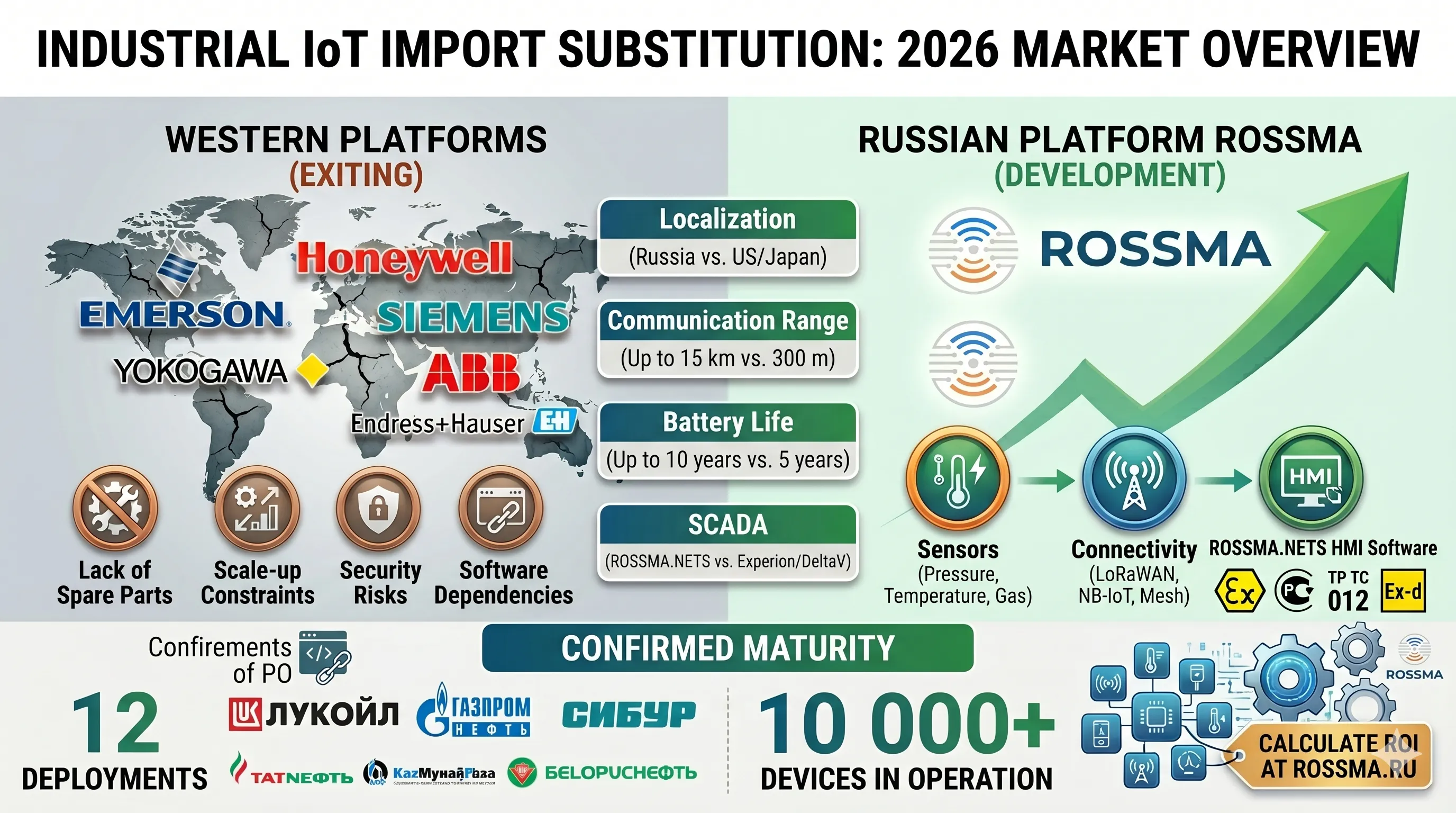
Industrial Internet of Things (IIoT) has become one of the critical fronts in Russia’s import substitution strategy. After major Western vendors — Emerson, Honeywell, Yokogawa, Siemens — ceased or restricted operations in Russia, enterprises in oil & gas, utilities, and manufacturing faced a critical problem: equipment is running, but spare parts are unavailable, technical support has been discontinued, and software licenses cannot be renewed. This article examines the current market landscape and compares the Russian ROSSMA platform against Western alternatives.
Why Industrial IoT Is a Key Front of Import Substitution
Automated Process Control Systems (APCS) are the nervous system of any industrial enterprise. Pressure, temperature, level, gas, and vibration sensors continuously collect data that drives equipment management decisions.
Until 2022, the Russian industrial wireless sensor market was almost entirely dependent on imports:
- Emerson (Rosemount, Fisher) — pressure and temperature transmitters, WirelessHART, DeltaV DCS
- Honeywell — OneWireless, Experion PKS, safety and gas detection
- Yokogawa — ISA100 Wireless, CENTUM VP, analytical instruments
- Siemens — SITRANS, PCS 7, industrial networks
- ABB — sensors, DCS, variable frequency drives
- Endress+Hauser — level, flow, and analytical instruments
Dependence on these vendors creates risks not only in new equipment procurement but also in servicing already installed systems: firmware cannot be updated, calibration requires proprietary software, and spare parts are under sanctions.
Exit of Emerson, Honeywell, Yokogawa: What Happened
In 2022–2023, the world’s largest industrial automation manufacturers ceased or significantly restricted their operations in Russia:
- Emerson — stopped deliveries, closed Russian office. DeltaV/AMS service contracts not renewed
- Honeywell — suspended sales and technical support. Experion PKS licenses not updated
- Yokogawa — restricted deliveries, technical support reduced to minimum
- Siemens — complete withdrawal from Russia, including industrial automation
For enterprises operating thousands of sensors from these manufacturers, this means: when equipment fails, replacement is impossible, and repairs rely on “grey” imports at multiples of the original price — with no warranty.
Risks of Dependence on Western Equipment
Operating Western equipment under current conditions carries specific risks:
- No spare parts — average industrial sensor lifetime is 10–15 years, but without spares, failures are critical
- Cannot scale — impossible to purchase additional sensors for new facilities
- Software dependency — DeltaV, Experion, CENTUM licenses require renewal
- Security — firmware updates unavailable, vulnerabilities remain unpatched
- CII compliance — critical information infrastructure facilities must transition to domestic software
Russian Alternatives: ROSSMA as a Full-Cycle Platform
ROSSMA is a Russian manufacturer of industrial IoT equipment offering a full cycle: from wireless sensors to a cloud SCADA platform. Unlike attempts to assemble “import substitution” from disparate components of different vendors, ROSSMA provides a unified ecosystem:
- Sensors — pressure, temperature, vibration, gas analysis, level, current (31 models)
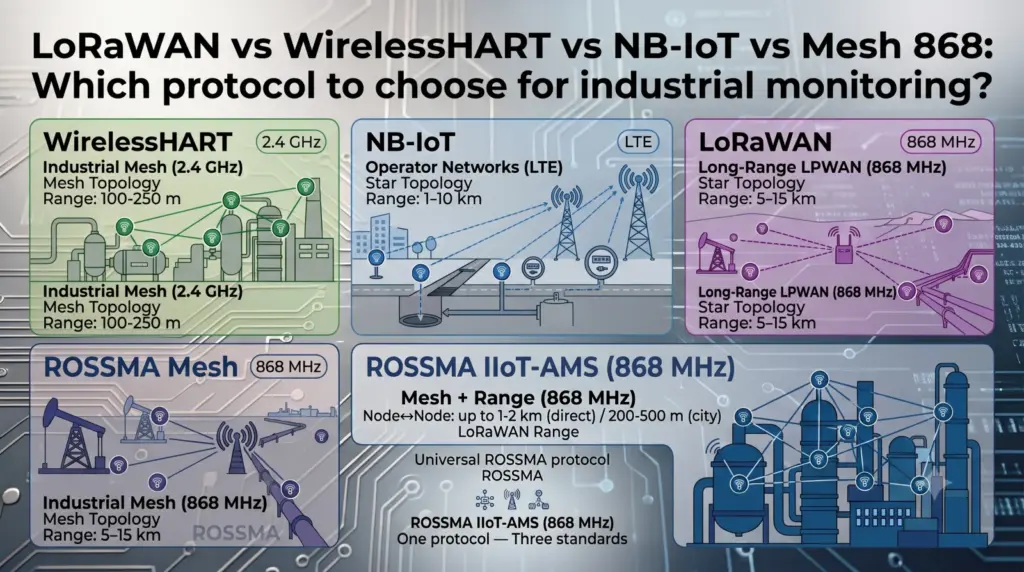
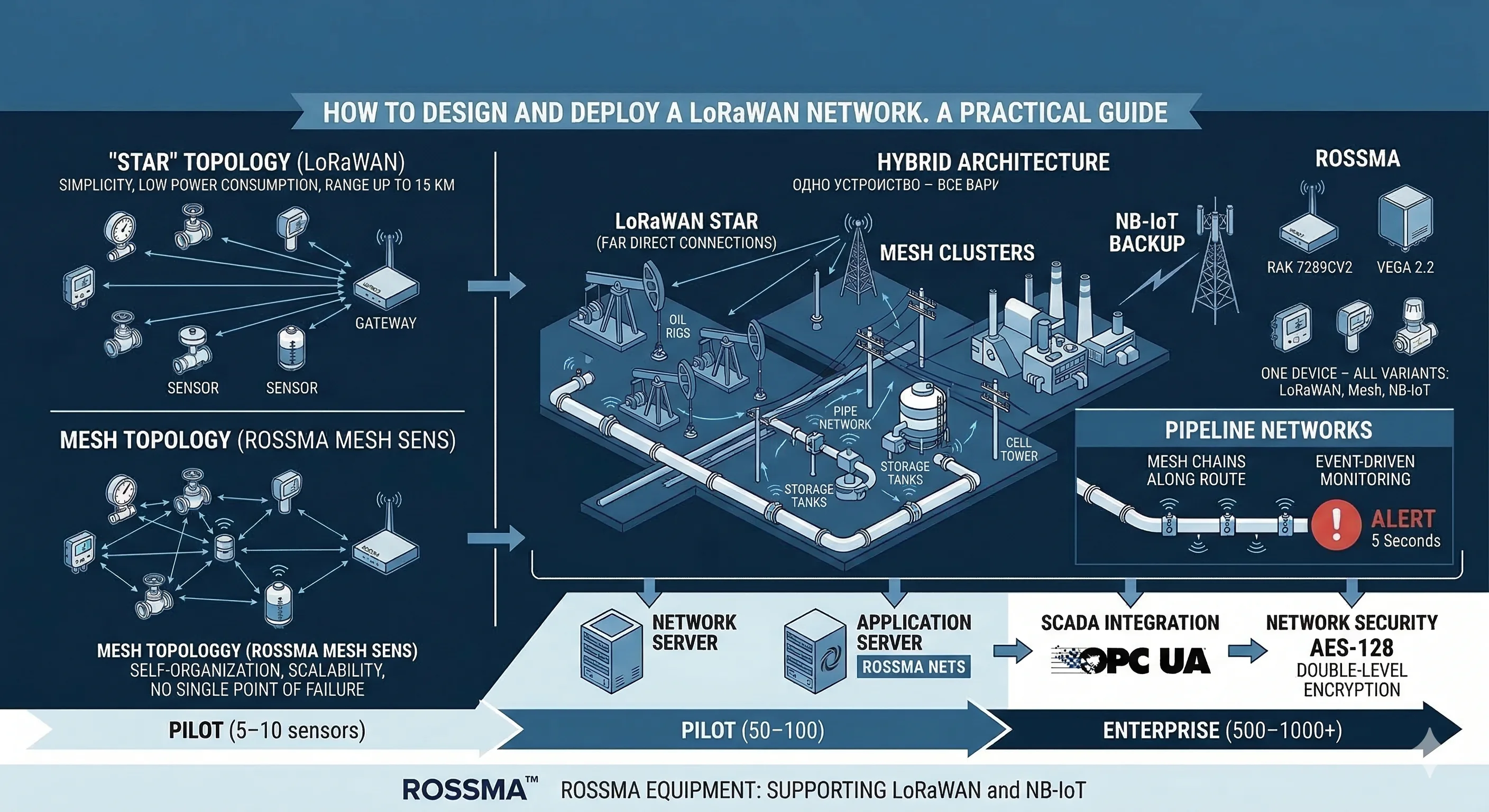
- Connectivity — LoRaWAN, NB-IoT, LTE, 868 MHz Mesh — all in one protocol
- Infrastructure — base stations, Modbus gateways, control relays
- Software — ROSSMA.NETS HMI (included in the Russian Software Registry No. 2024688076)
- Solutions — WellPAD for well pads, Pipeline Leak Detector
Comparison Table: ROSSMA vs Western Platforms
| Parameter | ROSSMA | Emerson | Honeywell | Yokogawa |
|---|---|---|---|---|
| Manufacturing | Russia | USA | USA | Japan |
| Russian SW Registry | ✓ (No. 2024688076) | — | — | — |
| Wireless protocol | LoRaWAN / NB-IoT / Mesh | WirelessHART | OneWireless (ISA100) | ISA100 |
| Communication range | 5–15 km | 100–250 m | 200–300 m | 200–300 m |
| Battery life | Up to 10 years | 3–5 years | 3–5 years | 3–5 years |
| Temperature range | −55…+85 °C | −40…+85 °C | −40…+85 °C | −40…+85 °C |
| Edge computing | ✓ (on-device setpoints) | — | — | — |
| SCADA included | ROSSMA.NETS HMI | DeltaV ($$$) | Experion ($$$) | CENTUM ($$$) |
| Spare parts | No restrictions | Sanctions | Sanctions | Limited |
| Tech support in Russia | 24/7, Russian | Discontinued | Discontinued | Limited |
Russian Software Registry and Certifications
The ROSSMA IIOT-NETS software platform is listed in the Unified Russian Software Registry (registration No. 2024688076). This ensures:
- Compliance with government procurement and CII facility requirements
- No dependency on foreign software licenses
- Support for Astra Linux and other Russian operating systems
ROSSMA equipment is certified to explosion-proof standards:
- ATEX — European standard for hazardous areas
- TR CU 012/2011 — Customs Union technical regulation
- IECEx — international certification
- Protection types: Ex d (flameproof enclosure), Ex ia (intrinsic safety), Ex e (increased safety)
12 Deployments: From LUKOIL to KazMunayGas
ROSSMA is not a startup with a prototype — it is a manufacturer with a proven base of over 10,000 devices in operation at major enterprises:
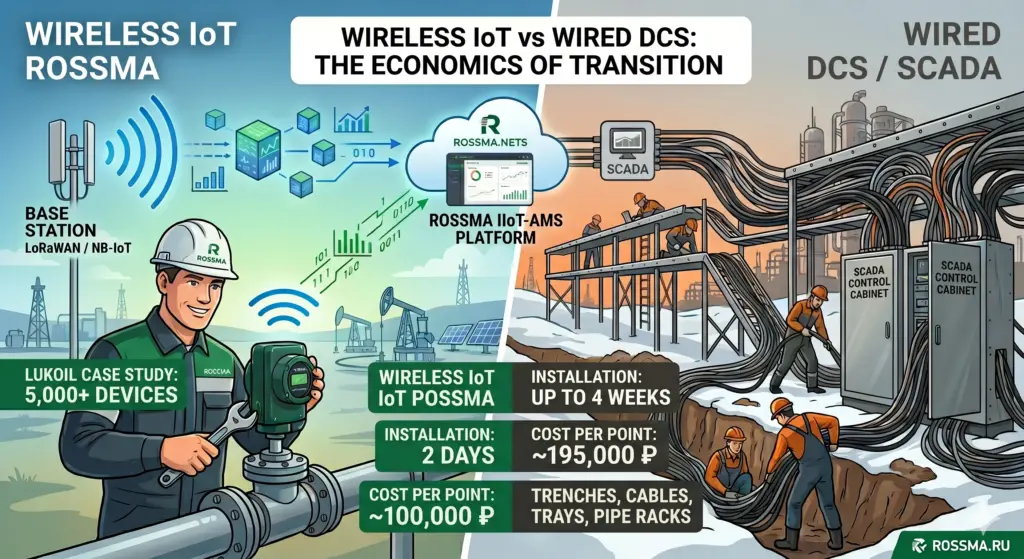
- LUKOIL — 5,000+ devices (Komi Republic, Perm Krai)
- Irkutsk Oil Company — 1,000+ devices (drilling, field operations)
- Gazprom Neft — well pad monitoring (KhMAO region)
- SIBUR — ZapSibNefteKhim, IIoT in hazardous zones
- Tatneft — “Digital Oilfield” program
- RussNeft (PJSC) — pipeline leak detection
- T Plus (TGC) — district heating networks (Perm, Yekaterinburg)
- TOT (De-Kastri) — industrial facility monitoring
- BelorusNeft — export project (Belarus)
- KazMunayGas — export project (Kazakhstan)
- UzbekNefteGaz — export project (Uzbekistan)
These deployments prove the platform’s maturity in real industrial conditions — from Arctic oilfields in Komi to the steppes of Uzbekistan.
How to Migrate to ROSSMA
Transitioning from Western equipment to ROSSMA does not require production shutdown. A typical migration program:
- Audit — inventory of existing equipment, identification of priority areas
- Pilot — installation of 10–50 ROSSMA sensors in parallel with the existing system
- Integration — connection to existing SCADA via Modbus/HART or transition to ROSSMA.NETS
- Scaling — phased replacement as Western equipment reaches end-of-life
With native Modbus RTU and HART protocol support, ROSSMA sensors integrate with existing infrastructure without replacing the entire system. Calculate your transition savings using our ROI calculator.
Related Products and Solutions
- Wireless pressure sensors — replacement for Emerson Rosemount 3051, Honeywell STD
- Wireless temperature sensors — replacement for Emerson 648, Yokogawa YTA
- Vibration sensors for predictive analytics
- Gas detectors — Ex d, CH4/H2S/CO
- ROSSMA.NETS — SCADA platform (Russian SW Registry)
- Oil & gas monitoring solutions
- ROI Calculator — calculate transition payback