LoRaWAN vs NB-IoT: Which Technology to Choose for Industrial IoT
Comparison of two main LPWAN technologies for industrial IoT. Pros and cons of LoRaWAN and NB-IoT for oil and gas, utilities and industry.
Introduction
When choosing wireless technology for industrial IoT, engineers face a key question: LoRaWAN or NB-IoT? Both technologies belong to the LPWAN (Low Power Wide Area Network) class and provide long-range data transmission with minimal power consumption. However, there are fundamental differences between them that are critically important when selecting a solution for a specific facility.
LoRaWAN Technology
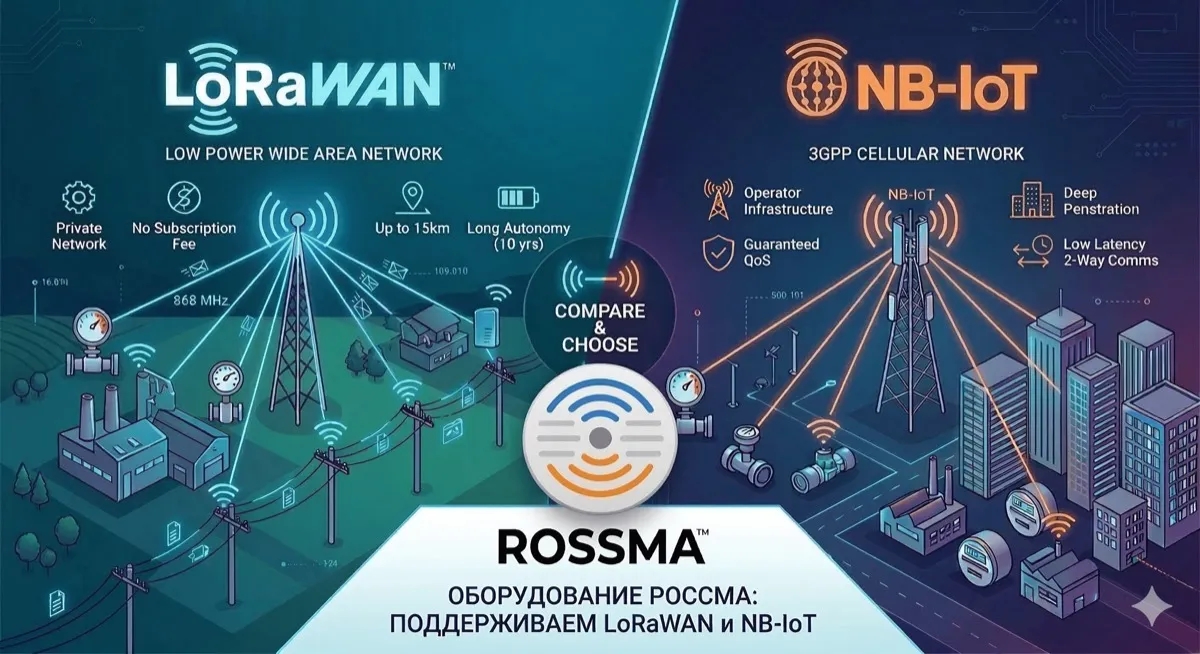
LoRaWAN (Long Range Wide Area Network) is an open protocol developed by the LoRa Alliance. It operates in unlicensed frequency bands (868 MHz in Europe/Russia, 915 MHz in Americas).
Key Advantages of LoRaWAN
Data Security — AES-128 Encryption
LoRaWAN provides two-level data protection: network-level encryption (NwkSKey) and application-level encryption (AppSKey) using the AES-128 algorithm. This means even the network operator cannot access user data — it is encrypted with a separate key. Each device receives a unique key pair upon activation, preventing mass compromise.
Superior Signal Penetration
Low transmission power (up to 25 mW) is compensated by Spread Spectrum modulation technology (LoRa CSS) — interference resistance down to -20 dB below noise level. Thanks to this, LoRaWAN signal reliably penetrates where NB-IoT loses connection:
- Manholes and collectors — reinforced concrete walls and covers are not an obstacle
- Basements and underground floors — stable communication through multiple floors of concrete
- Underground utilities — data transmission from underground at depths up to 1-2 meters
- Industrial facilities — metal structures and equipment create a shielding effect that LoRaWAN overcomes
High Interference Resistance
Chirp Spread Spectrum (CSS) technology at the core of LoRa provides exceptional interference resistance. The signal is spread across a wide frequency band, making it resistant to narrowband interference from industrial equipment, electric motors, frequency converters, and other electrical equipment on site. In industrial environments with high levels of electromagnetic interference, this is a critical advantage over NB-IoT.
Other advantages:
- Private network — full infrastructure control, independence from telecom operators
- No subscription fees — zero communication costs after deployment
- Range up to 15 km — line of sight, 3-5 km in urban areas
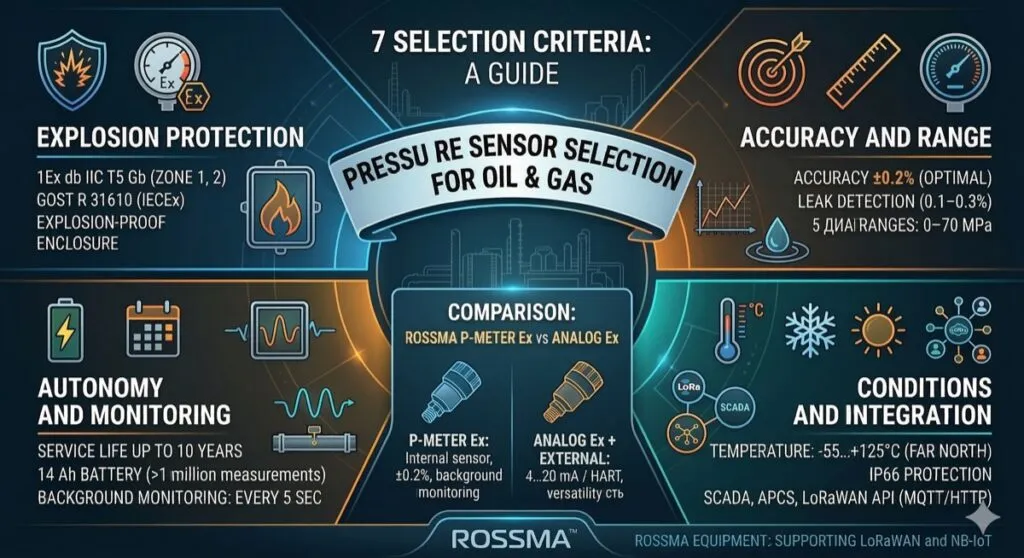
- Battery life up to 10 years — 14 Ah battery provides over 1,000,000 measurements
- Works without cellular coverage — at remote fields, forests, and isolated sites
NB-IoT Technology
NB-IoT (Narrowband IoT) is a 3GPP standard that uses existing cellular operator infrastructure. It operates in licensed spectrum.
NB-IoT advantages:
- Ready infrastructure — no need to deploy your own base stations
- Guaranteed quality of service (QoS) — operator standard
- Bidirectional communication with low latency — suitable for control commands
NB-IoT limitations:
- Operator dependency — no coverage = no communication
- Subscription fee per SIM card
- Worse signal penetration in difficult conditions (manholes, underground)
- Higher power consumption — battery drains faster
- Sensitivity to industrial electromagnetic interference
Comparison for Industrial Applications
| Parameter | LoRaWAN | NB-IoT |
|---|---|---|
| Encryption | AES-128 (two-level) | Standard LTE |
| Basement/manhole penetration | Excellent | Average |
| Underground operation | Yes (up to 1-2 m) | Difficult |
| Interference resistance | High (CSS) | Average |
| Range | Up to 15 km | Up to 10 km |
| Battery (14 Ah) | Up to 10 years | Up to 5 years |
| Subscription fee | None | Yes |
| Own infrastructure | Yes | No (operator) |
| Deployment | Base station needed | Ready immediately |
For remote oil and gas facilities, underground utility infrastructure, and industrial sites with high interference levels — LoRaWAN is the only viable solution. NB-IoT may be justified in urban conditions with guaranteed cellular coverage and real-time bidirectional communication needs.
ROSSMA equipment supports both technologies — LoRaWAN and NB-IoT. This allows choosing the optimal option for a specific site or using a hybrid approach.
Conclusions
For most industrial applications, we recommend LoRaWAN as the primary technology due to:
- Two-level AES-128 encryption
- Superior penetration (manholes, basements, underground)
- High interference resistance in industrial environments
- No subscription fees
- Sensor battery life up to 10 years
NB-IoT remains a backup option for sites with reliable cellular coverage. ROSSMA equipment works with both technologies without replacing sensors — simply switch the transmission mode.