LPWAN Networks for Industry: Architecture, Deployment and Scaling
How to design and deploy an industrial LPWAN LoRaWAN network. Star vs Mesh, base stations, coverage, SCADA integration.
Why LPWAN, Not Wi-Fi, Cellular or WirelessHART
| Requirement | Wi-Fi | Cellular | WirelessHART | LPWAN (LoRaWAN) |
|---|---|---|---|---|
| Range | 50–100 m | 1–5 km | 100–250 m | Up to 15 km |
| Battery life | Hours | Months | 3–5 years | Up to 10 years |
| Subscription | No | Yes (SIM) | No | No |
| Own infrastructure | No | No | No (HART GW) | Yes |
| Basement/manhole penetration | Poor | Average | Average | Excellent |
| Interference resistance | Low | Average | High (FHSS) | High (CSS) |
| Encryption | WPA2/3 | Operator | AES-128 | AES-128 (two-level) |
Industrial LPWAN Network Architecture
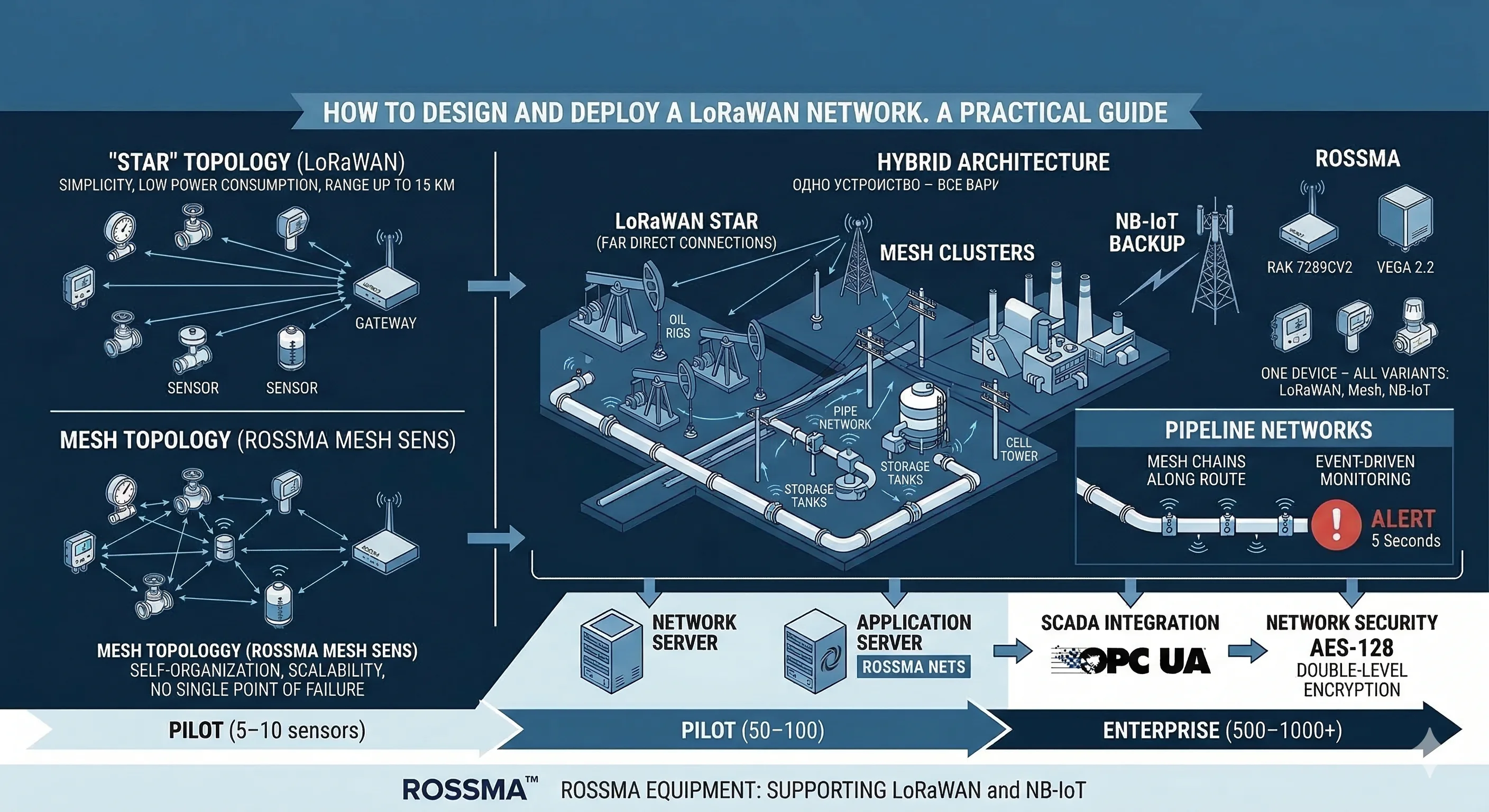
Star Topology — Classic LoRaWAN
End devices → Base stations → Network Server → Application Server (ROSSMA NETS). Up to 1000 sensors per base station, range up to 15 km.
Mesh Topology — ROSSMA MeshSens
Each node retransmits neighbor data. Self-organizing, no single point of failure, scales as nodes are added. Ideal for dense urban areas and utility infrastructure.
Hybrid Architecture
LoRaWAN star for remote sensors + Mesh clusters for dense groups + NB-IoT backup. ROSSMA equipment supports all three — switch via configurator.
Extended Pipelines: Mesh + Event-Driven Monitoring
Mesh Coverage Along Pipeline Routes
Linear Mesh chain of sensors every 0.5–2 km along pipeline. Each node relays to neighbors. Covers pipelines of any length without multiple base stations. Solar-powered for remote sections.
Event-Driven Mode
ROSSMA IIOT-AMS P-METER measures pressure every 5 seconds. Normal = sleep (zero transmission). Threshold exceeded = instant alert. Over 1,000,000 measurements per 14 Ah battery.
ROSSMA Pipeline Leak Detector
ROSSMA Pipeline Leak Detector — automatic leak detection by pressure patterns, section-level localization, Telegram/email alerts, SCADA integration via OPC UA/REST API.
ROSSMA IIOT-WellPAD — Well Pad Solution
ROSSMA IIOT-WellPAD — complete well pad monitoring: field sensors (P-METER, 1-Wire Ex, VPM, Tilt Counter Ex) → LoRaWAN base station → Edge PC (Astra Linux + Kaspersky) → SCADA/MES via VPN.
| Parameter | Wired APCS | ROSSMA WellPAD |
|---|---|---|
| Cost per pad | –60K | –15K |
| Installation | 2–4 weeks | 1–2 days |
| Earthworks | Yes | No |
| ROI | 3–5 years | 12–18 months |
Base Station Selection
| Parameter | VEGA 2.2 | RAK 7289CV2 |
|---|---|---|
| LoRa channels | 8 | Up to 16 |
| Protection | IP65 | IP67/NEMA-6 |
| Connectivity | Ethernet | Ethernet, Wi-Fi, 4G |
Coverage Planning
Use ROSSMA LPWAN Network Planner for terrain-aware coverage calculation.
Network Security
AES-128 two-level encryption (NwkSKey + AppSKey), unique keys per device (OTAA), frame counters against replay attacks, private network.
Conclusions
Industrial LPWAN on LoRaWAN: independence, AES-128 security, star/Mesh/hybrid flexibility, 10+ year battery, pilot in 1–2 weeks.
Ready to design? Use ROSSMA Network Planner or contact us.