How to Choose a Pressure Sensor for Oil and Gas Industry
Selection criteria for wireless pressure sensors for oil and gas: range, accuracy, explosion protection, battery life, signal penetration. P-METER Ex vs ANALOG Ex comparison.
Why Choosing a Pressure Sensor Is a Critical Task
At oil and gas facilities, a pressure sensor is not just an instrument — it is a safety system element. Incorrect readings or loss of communication can lead to pipeline accidents, equipment damage, or environmental disasters. Selection criteria for oil and gas are fundamentally different from standard industrial applications.
7 Criteria for Choosing a Pressure Sensor for Oil and Gas
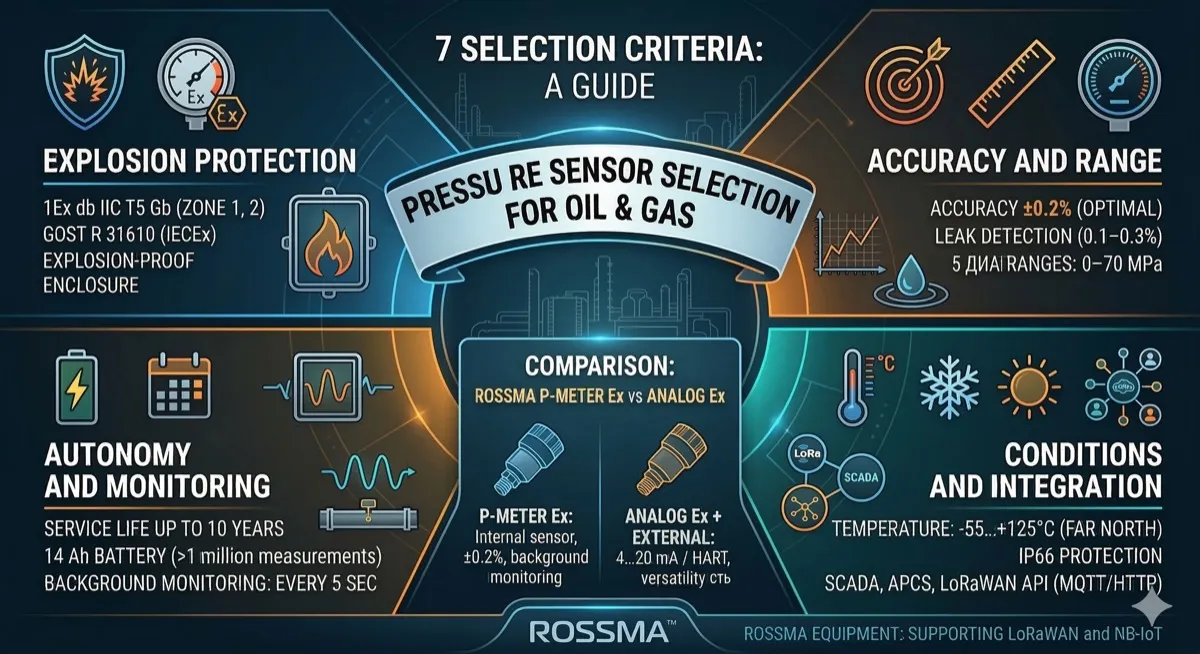
1. Explosion Protection — Mandatory Requirement
Oil and gas facilities are classified as Zone 1 and Zone 2 hazardous areas. All equipment must be certified to IECEx / GOST R 31610.
- Type “d” (flameproof enclosure) — most reliable for Zone 1. Marking: 1Ex db IIC T5 Gb
- Temperature class T5 (up to 100°C) is preferable to T4 — lower surface temperature
- Group IIC — strictest, includes hydrogen (all oil and gas environments)
ROSSMA P-METER Ex carries marking 1Ex db IIC T5 Gb X — flameproof enclosure, group IIC, temperature class T5.
2. Accuracy Class — Not All 0.5% Are Equal
In oil and gas, pressure measurement accuracy directly impacts leak detection, production optimization, and safety.
| Accuracy | Error | Oil & Gas Suitability |
|---|---|---|
| 1.5% | ±1.5% | Insufficient for most tasks |
| 0.5% | ±0.5% | Minimum acceptable |
| 0.2% | ±0.2% | Optimal — leak detection, precise metering |
ROSSMA P-METER Ex provides ±0.2% accuracy — 7.5× more precise than typical 1.5% solutions.
3. Measurement Range
Available ranges: 0–7 / 0–10 / 0–20 / 0–35 / 0–70 MPa — covering all typical oil and gas applications from flowlines to high-pressure gas pipelines.
4. Battery Life — Wired vs Wireless
Cable installation in explosion-proof conduit costs from ,000/km and takes months of planning. Wireless sensors with autonomous power solve this problem.
ROSSMA P-METER Ex with 14 Ah battery provides over 1,000,000 measurements. Background pressure monitoring every 5 seconds with virtually zero power consumption — data transmitted only when thresholds are exceeded. Real battery life: up to 10 years.
5. Monitoring Mode — The Key Differentiator
Background monitoring: sensor wakes every 5 seconds, compares pressure to thresholds. Normal = sleep without transmission. Threshold exceeded = instant alert. Continuous monitoring with minimal battery drain.
6. Temperature Range
| Parameter | ROSSMA P-METER Ex | Typical Competitors |
|---|---|---|
| Operating temperature | -55…+80°C | -40…+60°C |
| Media temperature | -40…+125°C | -20…+85°C |
| Protection | IP66 | IP65 |
7. Integration with SCADA and Cloud
LoRaWAN Network Server → MQTT/HTTP API → SCADA, ROSSMA NETS, ThingsBoard, Chirpstack.
P-METER Ex vs ANALOG Ex: Which to Choose?
| Parameter | P-METER Ex | ANALOG Ex + external sensor |
|---|---|---|
| Accuracy | ±0.2% | Depends on sensor (0.5–1.5%) |
| Background monitoring | Yes (every 5 sec) | No |
| Battery life | >1,000,000 measurements | ~40,000 packets |
| Flexibility | Pressure only | Any 4…20 mA sensor |
| Explosion protection | 1Ex db IIC T5 | 1Ex e IIC T4 |
Conclusions
7 key criteria for oil and gas pressure sensors: explosion protection (type “d”, IIC, T5), accuracy (0.2%), range, battery life (10 years), background monitoring, temperature range (-55°C), and SCADA integration.
Need help choosing? Use AI Equipment Selector or contact us.