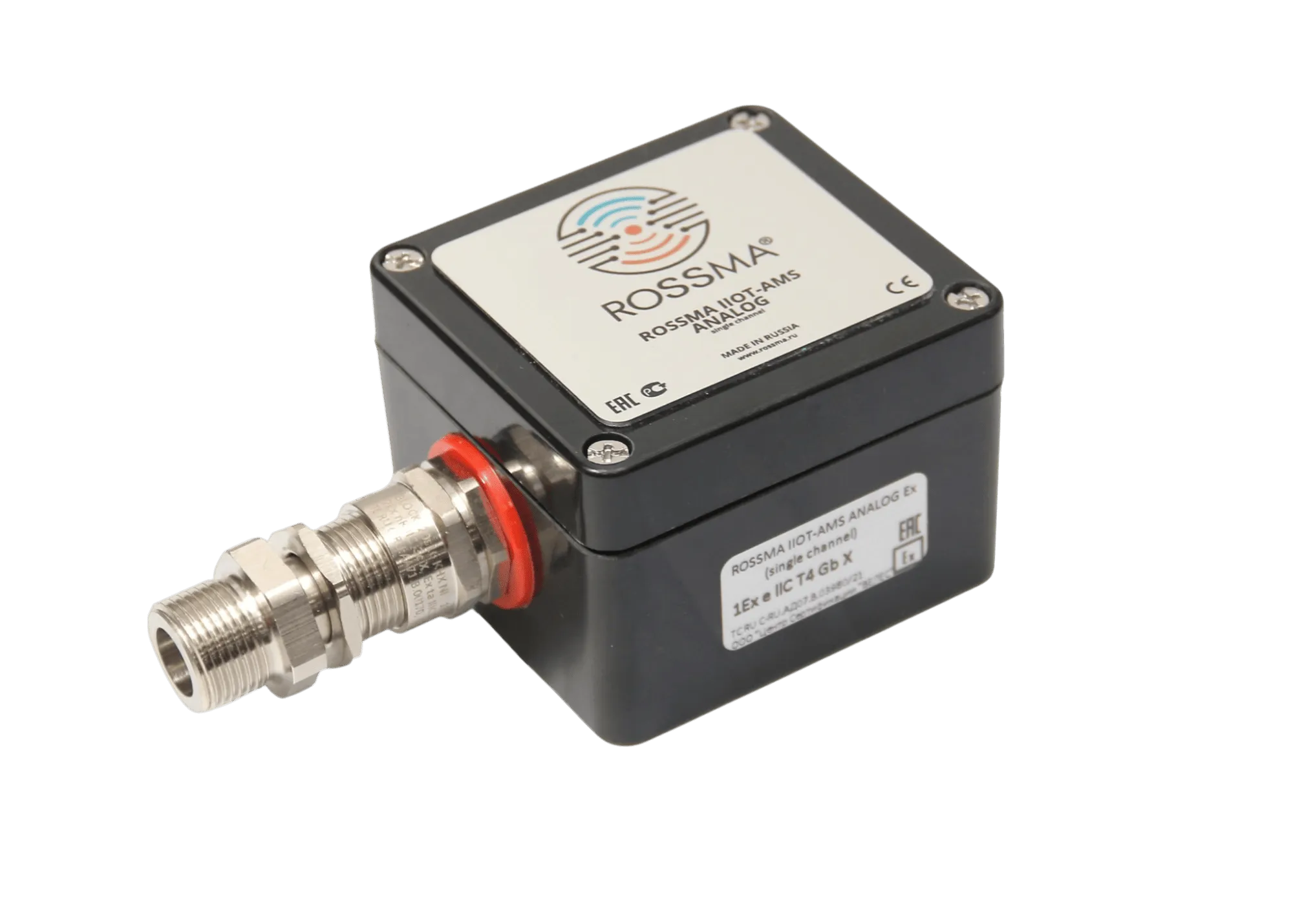
ANALOG Ex Single channel 14A/h LoRaWAN/NB-IoT
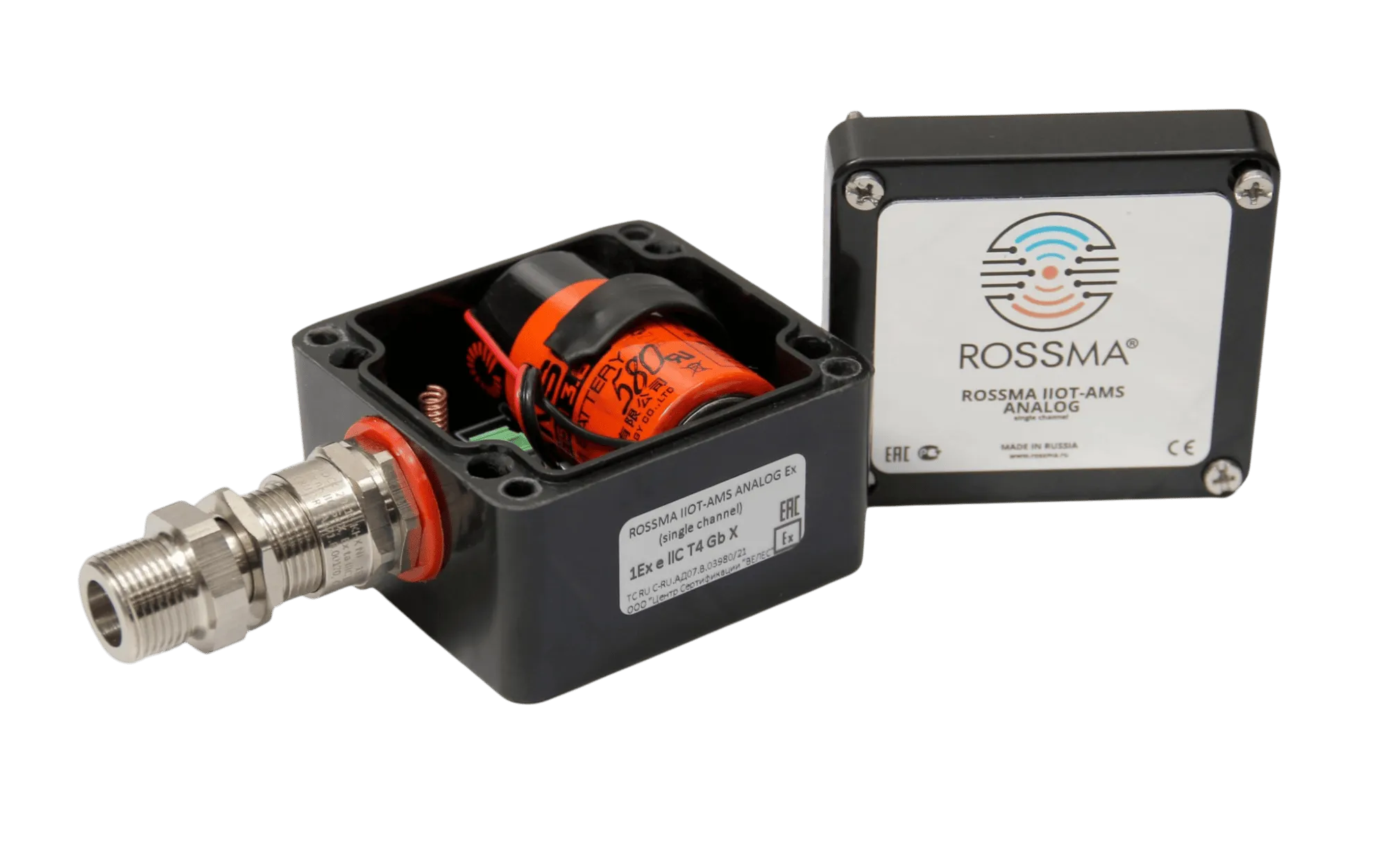
ANALOG Ex Single channel 14A/h LoRaWAN/NB-IoT
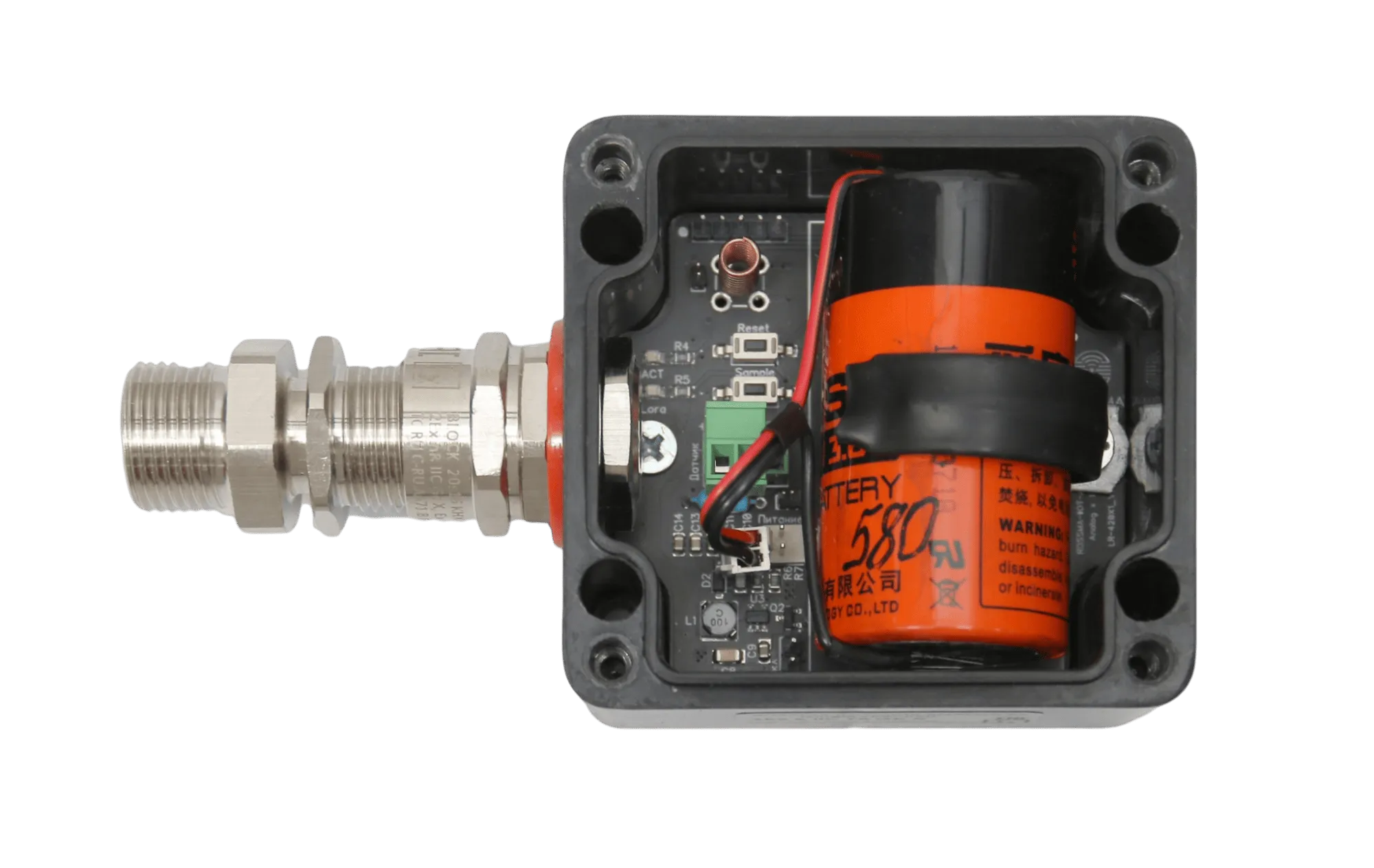
ANALOG Ex Single channel 14A/h LoRaWAN/NB-IoT
Autonomous Measuring and Switching Device ROSSMA® IIOT-AMS ANALOG Ex Single Channel
Single-channel autonomous measuring and switching device for analog (current and resistive) signals, as well as HART, with data transmission over LoRaWAN and NB-IoT wireless LPWAN networks.
Overview
Features
- 1 input per ROSSMA IIOT-AMS Analog Ex (single channel) measuring device
- Configurable measurement interval from 1 time/min
- On-demand measurement capability from upper level
- Supports both active (externally powered) and passive (powered directly from ROSSMA IIOT-AMS Analog Ex) instrumentation and sensors
GENERAL TECHNICAL SPECIFICATIONS:
- Connection interface: 4-20 mA current loop or resistive pt1000, Ni1000, TK5000; HART.
- Power type: 14 Ah; 126 Ah; 168 Ah; DC 3.3V;
- Communication interval/14 Ah battery discharge time: 1 min./90 days, 2 min./180 days, 10 min./300 days, 1 hr./3 years 150 days
- Operating temperature range t,°С: -55…+85
- Built-in temperature sensor: yes (sent with each communication)
- Antenna type: internal
- Supply voltage: built-in 3.6V battery, 14 Ah capacity, D-size.
- Built-in battery charge measurement: yes (sent with each communication)
- Housing dimensions, mm: 75×70×55/220x120x90/260x160x90
- Mounting: directly to sensor, cable ties to pole, DIN rail, wall
LoRaWAN TECHNICAL SPECIFICATIONS:
- LoRaWAN® device class: A
- LoRaWAN® activation: OTAA/ABP (configurable), ABP – default
- Transmitter output power: up to 100 mW (configurable), 25 mW default
- Sensitivity: -138 dBm
- Radio range: up to 5 km urban; up to 15 km rural.
- Frequency plan: EU-868/RU-868 (configurable)
NB-IoT TECHNICAL SPECIFICATIONS:
- Data rate: 25/20 kbps (single–tone) or 60 kbps (multi–tone) (DL/UL)
- RF bands: B1/2/3/5/8/12/13/17/18/19/20/25/26/28/66/70
1ExeIICT4 Gb, IP66
Autonomous up to 10 years
Documentation

User Manual Open in Wiki ↗
ROSSMA IIOT-AMS ANALOG meter-switch is designed for data acquisition from monitoring and measuring instruments with current interface 4…20 mA and/or 4…20 mA+HART and/or resistive interface such as pt1000, Ni1000, TK5000, with subsequent wireless data transmission. It can be used at industrial facilities, housing and communal services infrastructure, and in hard-to-reach locations. The meter-switch enables installation of monitoring instruments in places without power supply and operates in harsh climatic and weather conditions.

Depending on configuration, devices are equipped with a built-in 3.6 V battery with capacity of 14 Ah, or built-in battery packs with 3.6 V voltage and capacity of 126 Ah or 168 Ah. Simultaneously, the meter-switch can be powered from an external DC source with voltage from 3.3 V.
WARNING: Meter-switches are equipped with non-rechargeable lithium-thionyl chloride (LiSOCl2) battery ER34615M/T manufactured by Fanso. Attempts to charge the battery may cause fire!
ROSSMA IIOT-AMS ANALOG is equipped with one analog input, or one analog input with HART protocol support, or four analog inputs.
Device Modifications
Single Channel:
- ROSSMA IIOT-AMS ANALOG Single channel
- ROSSMA IIOT-AMS ANALOG Ex Single channel (explosion-proof)
- ROSSMA IIOT-AMS ANALOG Ex Single channel 126 Ah (increased capacity)
- ROSSMA IIOT-AMS ANALOG Ex Single channel 168 Ah (maximum capacity)
Four-Channel (X4):
- ROSSMA IIOT-AMS ANALOG X4
- ROSSMA IIOT-AMS ANALOG X4 PWR (with 220V power)
- ROSSMA IIOT-AMS ANALOG Ex X4 (explosion-proof)
- ROSSMA IIOT-AMS ANALOG Ex X4 168 Ah
- ROSSMA IIOT-AMS ANALOG Ex X4 (DC 3.3V)
Explosion-proof modifications (Ex) have explosion protection marking 1Ex e IIC T4 Gb X and are designed for operation in hazardous areas according to GOST R 31610.0-2014. Protection degree IP66.
Operating Principle
The meter-switch supports two operating modes:
✅ Working with Active Instruments
Operating with monitoring and measuring instruments powered by an external power source.
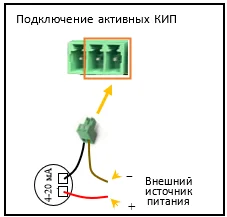
Figure 1. Connecting active control and measuring instruments to ROSSMA IIOT-AMS ANALOG X1
✅ Working with Passive Instruments
Operating with monitoring and measuring instruments powered by the meter-switch's built-in battery.
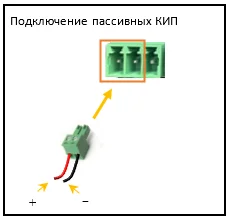
Figure 2. Connecting passive control and measuring instruments to ROSSMA IIOT-AMS ANALOG X1
Operating Algorithm:
- Data is read from the monitoring instrument with a configurable period starting from 30 seconds. Data is stored in meter-switch memory and transmitted during scheduled wireless sessions at set intervals.
- Data transmission period can be configured from 30 seconds. By default, manufacturer sets data transmission interval to once every 15 minutes. Data transmission is performed by a timer set in the meter-switch's internal memory.
- Meter-switch communication timing management is performed via network server and can be adjusted by command.
Technical Specifications
General characteristics:
- Connection interface: 4-20 mA current loop or resistive pt1000, Ni1000, TK5000; HART.
- Operating temperature range t,°C: -55…+85
- Built-in temperature sensor: yes (sent with every connection)
- Antenna type: internal
- Built-in battery charge measurement: yes (sent with every connection)
- Mounting: directly to sensor, with cable ties to support, on DIN rail, wall-mounted
Power type: Built-in 3.6 V battery, capacity 14 A/h, D size
Battery life:
| Transmission interval | Service life |
|---|---|
| 1 min | ~90 days |
| 2 min | ~180 days |
| 10 min | ~300 days |
| 1 hour | ~3 years 150 days |
| 24 hours (once per day) | ~10 years |
Housing dimensions: 75×70×55 mm
Application: Standard operating conditions, frequent data transmission
Maximum number of packets: 40,000 ± 10%
Power type: Built-in 3.6 V battery pack, capacity 126 A/h
Battery life:
| Transmission interval | Service life |
|---|---|
| 1 min | ~2 years |
| 2 min | ~4 years |
| 10 min | ~7 years |
| 1 hour | ~10 years* |
| 24 hours (once per day) | ~10 years* |
Housing dimensions: 220×120×90 mm
Application: Hard-to-reach locations, rare battery replacement
Maximum number of packets: 360,000 ± 10%
Modifications:
- ROSSMA IIOT-AMS ANALOG Ex Single channel 126 Ah
Power type: Built-in 3.6 V battery pack, capacity 168 A/h
Battery life:
| Transmission interval | Service life |
|---|---|
| 1 min | ~3 years |
| 2 min | ~6 years |
| 10 min | ~10 years* |
| 1 hour | ~10 years* |
| 24 hours (once per day) | ~10 years* |
Housing dimensions: 260×160×90 mm
Application: Critical facilities, maximum autonomous operation time
Maximum number of packets: 480,000 ± 10%
Modifications:
- ROSSMA IIOT-AMS ANALOG Ex Single channel 168 Ah
- ROSSMA IIOT-AMS ANALOG Ex X4 168 Ah
Power type: External DC source from 3.3 V
Service life: Unlimited (depends on power source)
Housing dimensions: 75×70×55 mm
Application: Sites with available power supply, continuous operation
Modifications:
- ROSSMA IIOT-AMS ANALOG Ex X4 (DC 3.3V)
* Maximum service life of lithium-thionyl chloride batteries is limited to 10 years due to natural self-discharge, regardless of capacity.
LoRaWAN Technical Specifications:
- Device class in LoRaWAN network: A
- Activation in LoRaWAN network: OTAA/ABP (configurable), ABP – default
- Transmitter output power: up to 100 mW (configurable), default 25 mW
- Sensitivity: -138 dBm
- Radio communication range: up to 5 km in urban areas; up to 15 km in rural areas.
- Frequency plan: EU-868/RU-868 (configurable)
NB-IoT Technical Specifications:
- Exchange speed: 25/20 kbps (single-tone) or 60 kbps (multi-tone) (DL/UL)
- Radio frequency bands: B1/2/3/5/8/12/13/17/18/19/20/25/26/28/66/70
Structurally, the meter-switch consists of components:
- controller;
- transmitter;
- boost converter;
- voltage divider;
- logic switches;
- power supply.
Functional Capabilities
ROSSMA IIOT-AMS ANALOG supports autonomous operation and wireless data transmission for the following sensor types:
- Optical sensors
- Position sensors (distance)
- Gas flow sensors
- Temperature sensors
- Current sensors
- Angle sensors (encoders)
- Ultrasonic sensors
- Liquid level sensors
- Force sensors
- Acceleration sensors (accelerometers)
- Liquid flow detectors
- Humidity sensors
- Gas sensors
- Non-contact sensors
- Motion sensors
- Tilt sensors
- Load cells
- Pressure sensors
- Photointerrupters
- Photoelectric sensors
- Magnetic field sensors (Hall sensors)
Installation
Installation Instructions
IMPORTANT: To ensure proper functioning, installation and configuration of the meter-switch must be performed by qualified personnel.
- Remove top covers from ROSSMA switch and pressure sensor.
- IMPORTANT! Disconnect board power supply. Remove connector Pos 3 from mating part Pos 2 Fig.5.
- Prepare required length of KSPV 2×0.5 cable (about 10 cm.)
- Strip cable on both sides (about 5 mm).
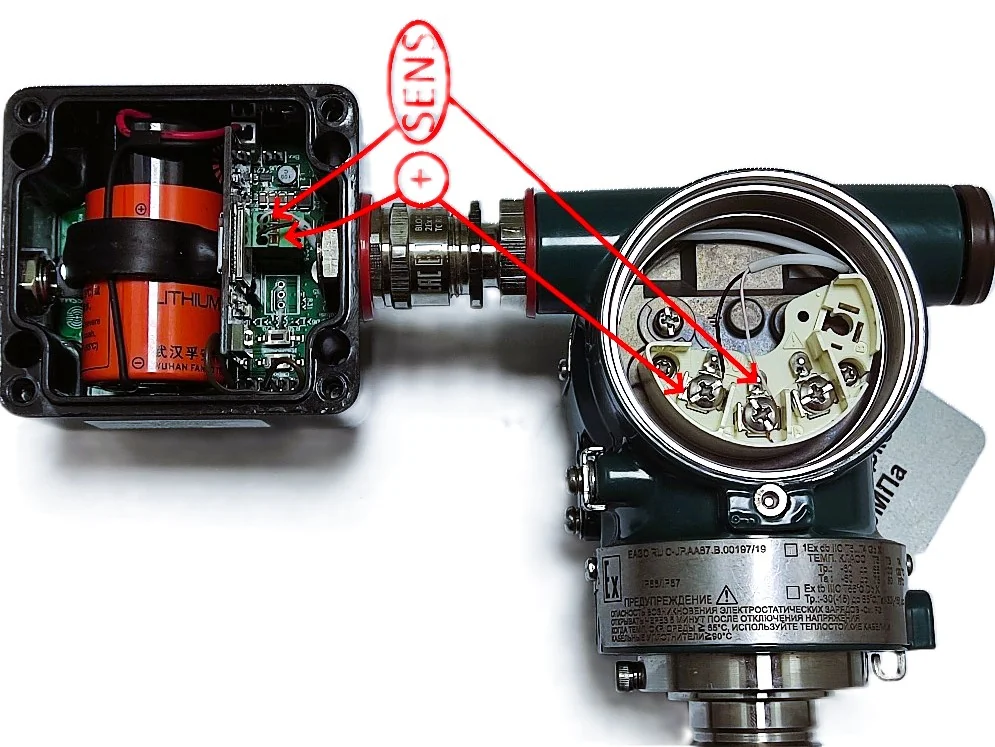
- Connect cable to ROSSMA switch at connector fig. 3. Pos 4. according to diagram Fig 4.
- Pass cable through switch cable gland (Fig 3. Pos 1.)
- Connect cable to pressure sensor according to diagram Fig 4.
- Tighten cable glands with required wrenches.
- Close pressure sensor top cover.
- Connect power connector fig 5. Pos 3. To mating part Fig 5.pos 2.
- Install top cover on ROSSMA switch (Fig 1. Pos 1,2,3,4)
Explosion-proof version: When installing in hazardous areas, follow PUE chapter 7.3 "Electrical installations in hazardous areas" and GOST 31610.7-2012.
Interface Connection
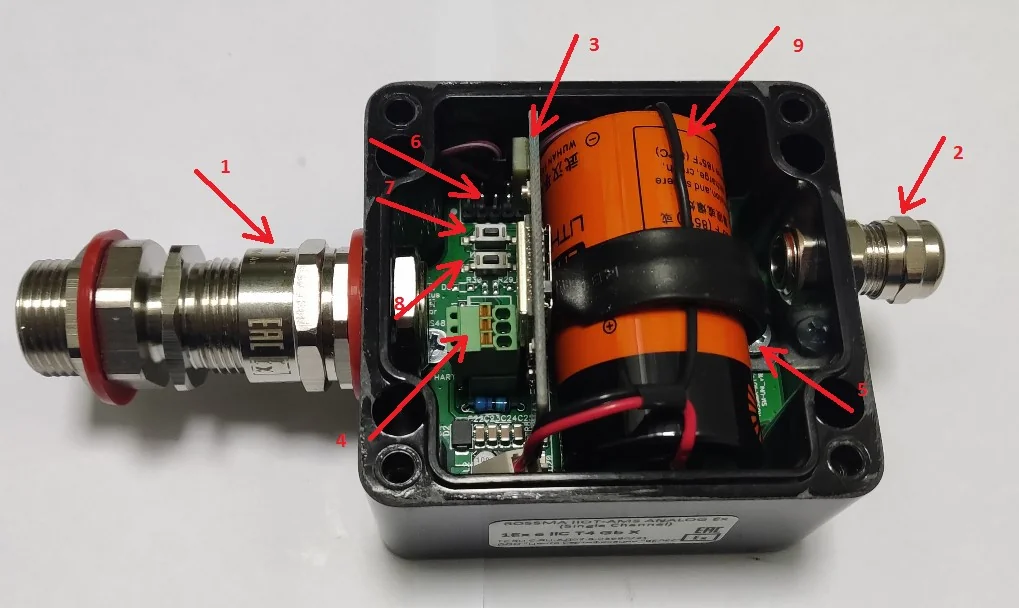
Fig.3 - Connector Description:
- Cable gland for pressure sensor connection
- Cable gland for additional antenna installation
- Communication module (NB IoT, optional - LoRa)
- Equipment/instruments connection connector (pressure sensors)
- Battery bracket mounting screw
- Programming connector
- "RESET" button
- "Measure and send" button
- Battery
LED Indication
- "Status" LED blinks periodically – data transmission to server in progress.
- "Error" LED blinks once per second – communication module not detected or faulty.
- "Error" LED blinks in sequence three times – pause – three times – ROSSMA switch cannot register in network and obtain IP address.
- "Error" LED blinks in sequence five times – pause – five times – network server data transmission error.

Battery Replacement
IMPORTANT: Battery replacement must be performed by qualified personnel. Repair and maintenance of meter-switch by consumer is not allowed!
When is battery replacement needed?
Approximate battery life up to 10 years with data transmission once per day. Battery capacity of 14 Ah is designed for sending 40,000 data packets ± 10%.
If meter-switch malfunction is detected, check battery voltage. Device transmits voltage data with every connection.
Replacement Instructions
- Turn off meter-switch (disconnect battery connector from board connector)
- Unscrew screw securing bracket inside housing
- Remove battery and bracket from housing
- Install new battery in housing
- Install bracket on battery and secure with screw
- Connect battery to power connector on board
- Check LED indication
CRITICAL: Use only non-rechargeable lithium-thionyl chloride (LiSOCl2) battery ER34615M/T manufactured by FANSO. Otherwise, manufacturer does not guarantee proper operation!
Battery technical parameters:
- Type: ER34615M/T (Fanso)
- Voltage: 3.6 V
- Capacity: 14 Ah
- Form factor: D
- Chemistry: LiSOCl₂ (lithium-thionyl chloride)
Firmware
Main Firmware (SM-UNI)
Version: 0.2.5 (19.12.2024) — ⬇️ Download
What's new in v0.2.5:
- Added communication interval query command (0x06 on port 3)
- Added HART sensor polling control (on/off)
- Added HART sensor polling control commands
📋 Version History
v0.2.3 (16.10.2024) — ⬇️ Download
- Added communication module firmware version data to BE packet
- Removed hard-coded region setting option
v0.2.2 (12.10.2024) — Archive data selection algorithm improvements, debug mode
v0.2.1 (08.10.2024) — Message send status check, sleep transition algorithm
v0.2 (07.10.2024) — Startup packet 0xBE, archive and log module v2, queue mechanism, command 0x41
v0.1 (20.04.2024) — First LoRaWAN version
LoRaWAN Communication Module Firmware
Version: 0.5.0 (19.12.2024) — ⬇️ Download
What's new in v0.5.0:
- Changed main board notification packet format
- Improved data sending module to main board
📋 Version History
v0.4.3 (16.10.2024) — ⬇️ Download
- Main algorithm improvements
- Changed version request format
v0.4.2 (12.10.2024) — Reworked message sending algorithm, fixed duplicates
v0.4.1 (09.10.2024) — Version request command, fixed "0001" sending, new version system
LR-HRT11 Firmware (Single Channel LoRaWAN)
Version: 1.6.0 (02.09.2024) — ⬇️ Download
What's new in v1.6.0:
- New build system
- Added LR-HRT11-V45Metran board support
- Added new version request format
For Metran/Yokogawa: ⬇️ Download lr-hrt11-metran-v1.6.0.hex
📋 Version History
v1.5 (02.03.2024)
- Added retry (2 attempts) for each HART sensor request
- Transferred analog value recalculation algorithm from LR-420x4
- Added universal sensor processing algorithm
v1.4 (09.11.2023)
- Added reed switch support (packet type 0xCE)
- Added short and long button press logic
v1.3.3 (31.03.2023) — Fixed packet length
How to update: Use ST-LINK programmer for flashing via SWD interface.
Configuration and programming go to
Works with the following sensors:
The ROSSMA IIOT-AMS Analog autonomous measuring and switching device is a universal wireless device. As a result, it is compatible with instrumentation (sensors) from a wide range of manufacturers. The ROSSMA IIOT-AMS Analog provides autonomous operation and wireless data transmission in Low Power Wide Area Networks (LPWAN) of LoRaWAN and NB-IoT standards. The device supports autonomous operation and wireless data transmission for the following sensor types:
- Magnetic field sensors (Hall sensors)
- Optical sensors
- Position (distance) sensors
- Gas flow sensors
- Temperature sensors
- Current sensors
- Angle sensors (encoders)
- Ultrasonic sensors
- Liquid level sensors
- Force sensors
- Acceleration sensors (accelerometers)
- Liquid flow detectors
- Humidity sensors
- Gas sensors
- Non-contact sensors
- Motion sensors
- Tilt sensors
- Strain gauges
- Pressure sensors
- Photo interrupters
- Photoelectric sensors
The equipment is registered in the Registry of the Ministry of Industry and Trade of the Russian Federation as equipment manufactured in the Russian Federation (Certificate 48859/11 dated 11.06.2021).
Software
Configurator application for remote configuration of ROSSMA® IIOT-AMS switching devices