Wireless IIoT vs Wired SCADA: Economics of the Transition
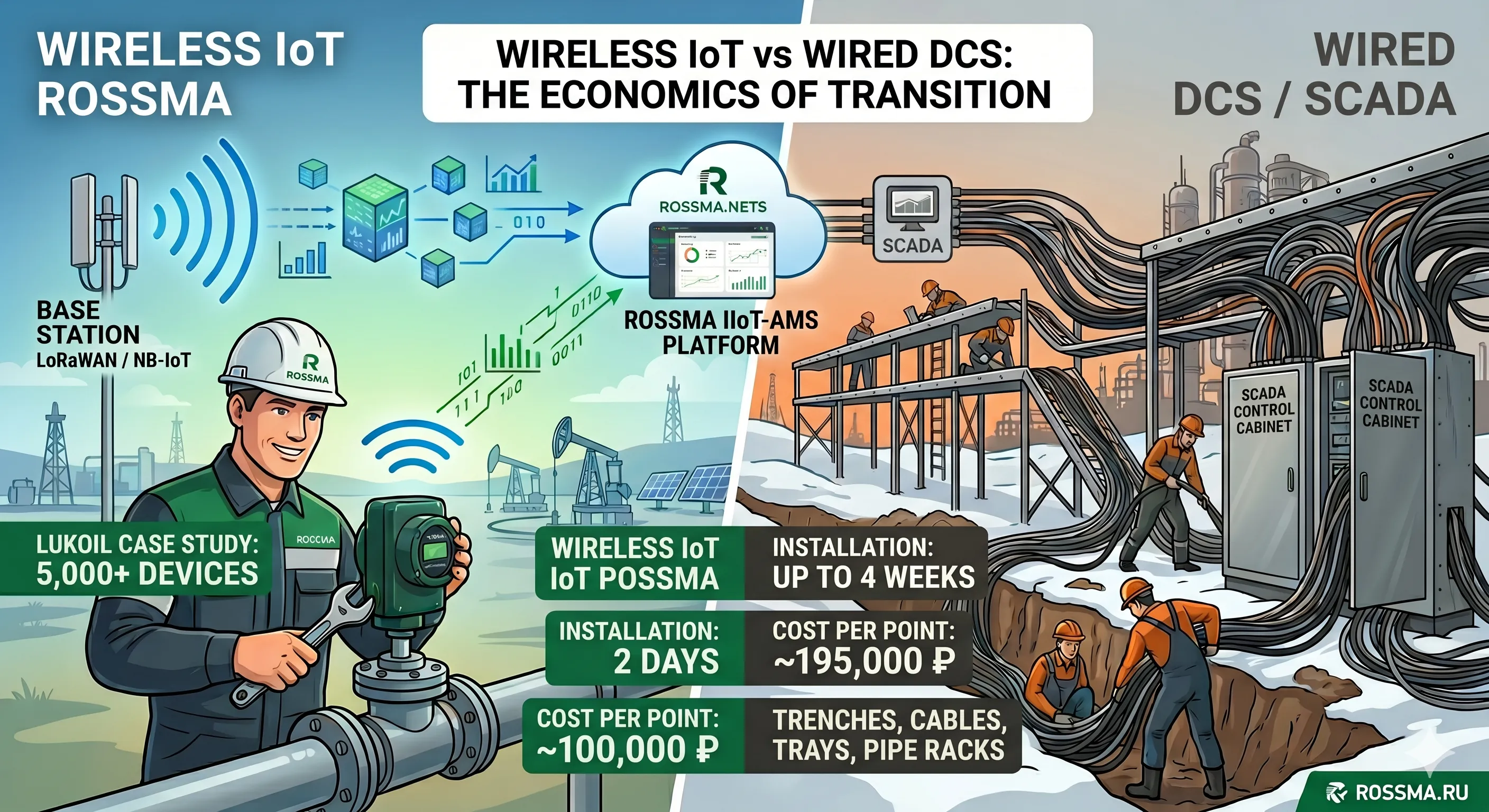
Comparing ROSSMA wireless IoT against wired SCADA: $1,120 vs $2,150 per point, installation 2 days vs 4 weeks. LUKOIL case study — 5,000+ devices.
Wired automation — cables, trenches, cable trays — was for decades the only option for industrial monitoring. But its economics are heavy: 3–6 million RUB per single wellpad, 2–4 weeks of installation, and the inability to scale quickly. Wireless industrial IoT based on LoRaWAN/NB-IoT changes this economics radically — but not everywhere and not always. Let us be honest about where the switch delivers a 60–65% cost cut, and where wired SCADA is still justified.
In short: the key figures
- −65% CapEx to equip a wellpad (10.5 vs ~30.5 million RUB for 100 points)
- 2 days vs 4 weeks — site installation time
- 0 RUB for cable, trenches and cable trays
- 5,000+ ROSSMA devices in a single project (LUKOIL)
- −55 °C operating temperature, replaceable battery every ~3 years
Why wired ICS is losing ground
Wired industrial control systems rely on 4–20 mA analog signals and HART/Foundation Fieldbus digital protocols. Each sensor is connected to the controller by a twisted pair or coaxial cable. The architecture has worked for decades — but it has systemic problems:
- Cable laying cost — 500 RUB/m × 200–500 m to each sensor + trenches, trays, penetrations
- Installation time — 2–4 weeks per wellpad (earthworks, laying, commissioning)
- Rigidity — adding a new monitoring point means a new cable from the sensor to the cabinet
- Maintenance — cable damage (rodents, corrosion, mechanical) requires excavation
- Far North — in permafrost you do not dig: cable is routed along above-ground cable overpasses (steel structures on piles with foundations) — a separate, very expensive item
Hidden costs: cable, trenches, maintenance
When estimating a wired system, only the sensor is often counted. But the main costs are in the infrastructure:
| Cost item | Per point | Comment |
|---|---|---|
| Sensor (wired) | 42,500 RUB | Cheaper than wireless, but only ~20% of TCO |
| Cable (200 m) | 100,000 RUB | 500 RUB/m × 200 m (average distance) |
| Trench / tray / overpass | 30,000–150,000 RUB | In the Far North there is no digging — cable runs on overpasses on piles (pricier than trenches) |
| Installation and commissioning | 52,500 RUB | ×3.5 the wireless installation |
| TOTAL per point | 195,000–345,000 RUB | 2–3.5× more expensive than wireless |
For an oilfield wellpad with 50–100 points this is 10–27 million RUB on infrastructure alone.
Moreover, a modern cable route at an industrial site is, as a rule, fiber optics, not just copper. That adds a whole layer of equipment for building the optical network that is almost always forgotten at the start:
- Optical trunk cable + protective conduit/tray
- Optical splice closures and optical distribution frames (ODF) in cabinets
- Fiber fusion splicing — special tooling (splicer, OTDR reflectometer) and qualified technicians
- Media converters and interface converters (4–20 mA / RS-485 → Ethernet/fiber) for each group of sensors
- Industrial managed switches with SFP modules
- Field RTUs/controllers to digitize analog signals before transmission over fiber
That is another tens to hundreds of thousands of RUB of active equipment per site — on top of the cable and earthworks. All of it is counted as a separate “Optical network” line in the 100-point summary below.
Wireless IoT: how it works
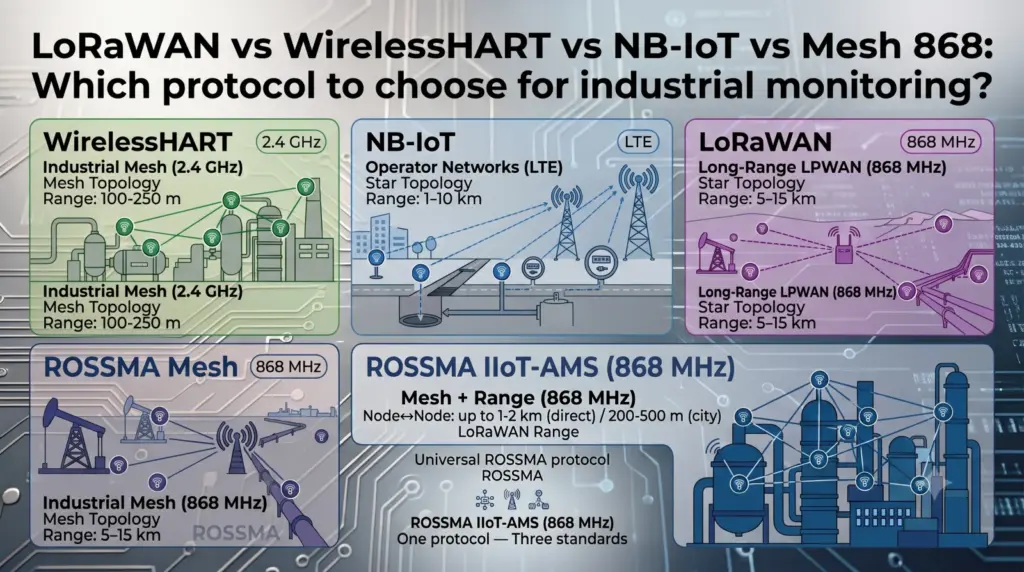
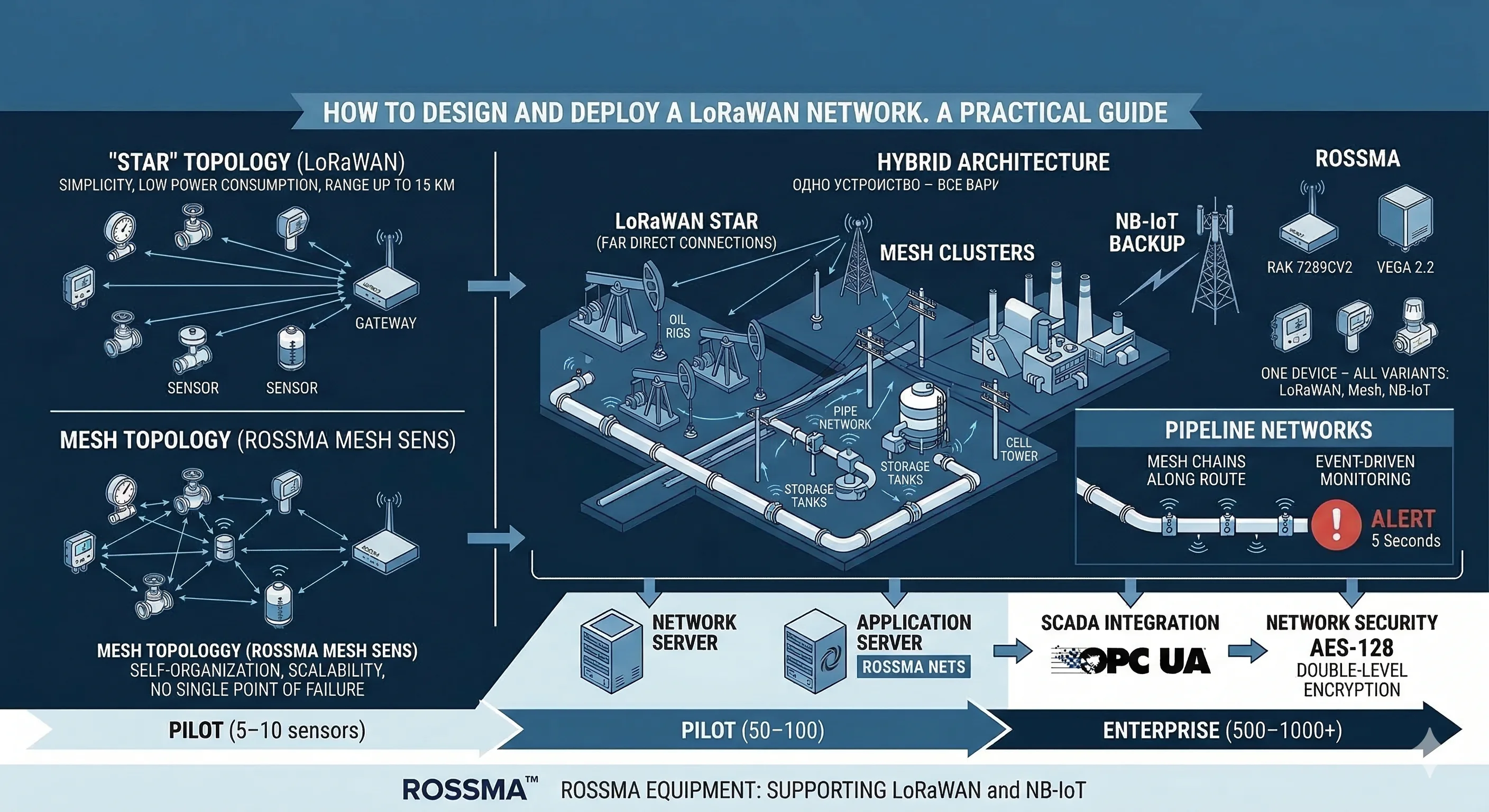
The ROSSMA IIoT-AMS platform uses wireless LPWAN technologies to transmit data from sensors to the network server:
- A smart device (pressure, temperature, vibration, etc.) measures the parameter, runs local logic and transmits data over the radio channel
- A base station (LoRaWAN/Mesh) or an operator network (NB-IoT/LTE) receives the data
- ROSSMA.NETS — a single network server: all communication standards arrive at one point regardless of technology
- ROSSMA.NETS HMI — in-house SCADA: visualization, setpoints, alerts
No cables, trenches or trays. Installing one device takes 15–30 minutes (mount, switch on, register in the network). Importantly, ROSSMA devices run on a single proprietary secure protocol on top of any communication standard (LoRaWAN, NB-IoT, LTE, 868 MHz Mesh) — the customer is not locked to an operator and can combine technologies on the same site.
Comparison: ROSSMA vs wired SCADA
| Parameter | ROSSMA (wireless) | Wired SCADA |
|---|---|---|
| Sensor cost | 85,000 RUB | 42,500 RUB |
| Cable per point | 0 RUB | 100,000 RUB |
| Installation per point | 15,000 RUB | 52,500 RUB (×3.5) |
| Total per point | ~100,000 RUB | ~195,000 RUB |
| Site installation time | 1–2 days | 2–4 weeks |
| Adding new points | Minutes | Weeks (new cable) |
| Cable maintenance | None | Excavation, replacement |
| Operation on damage | Other devices keep working | Cable break = data loss |
| Autonomy | Edge logic, 50,000-record archive | Depends on power and link |
Why is a wireless sensor twice as expensive as a wired one?
A fair question: 85,000 vs 42,500 RUB. The difference is not markup, but the fact that a ROSSMA wireless device is not a “sensor with a radio module” but an autonomous edge controller: built-in radio, a battery, its own processor running setpoint logic and an archive, and no separate 4–20 mA transmitter or intrinsic-safety barriers. A wired sensor is cheaper “in hardware” but requires 150,000+ RUB of infrastructure around it. The correct comparison is not the sensor price but the cost of the whole point — and there wireless is twice as cheap.
7-year TCO: counting total cost of ownership, not CapEx
CapEx is only half the story. Over the operating life, a wired system incurs recurring costs to maintain cable routes, while a wireless one needs only periodic battery replacement. Total cost of ownership of one point over 7 years:
| Item (7 years) | ROSSMA | Wired SCADA |
|---|---|---|
| CapEx (whole point) | 100,000 RUB | 195,000 RUB |
| Cable/route maintenance | 0 RUB | ~70,000 RUB (repairs, inspections) |
| Battery replacement | ~6,000 RUB (2 replacements over 7 years) | — |
| Downtime from breaks | ≈0 (autonomous buffer) | Data loss until repair |
| TCO over 7 years | ~106,000 RUB | ~265,000 RUB |
The gap widens over time: the longer the operation, the more expensive wired infrastructure becomes. Payback for a pilot is usually within the first year from cable and installation savings.
Where the savings peak: sensitivity to distance
The main driver of savings is the cable run length. The farther the sensor from the cabinet, the more advantageous wireless is. Conversely, on short runs the difference shrinks:
| Distance to point | Wired (point) | ROSSMA (point) | Saving |
|---|---|---|---|
| 30 m (near the cabinet) | ~110,000 RUB | ~100,000 RUB | ~10% (parity) |
| 100 m | ~150,000 RUB | ~100,000 RUB | ~33% |
| 200 m (typical) | ~195,000 RUB | ~100,000 RUB | ~49% |
| 500 m (remote object) | ~330,000 RUB | ~100,000 RUB | ~70% |
Bottom line: on short runs (<50 m) wired connection is competitive on price; from 100 m and for remote objects wireless IoT wins by a wide margin. For distributed fields with kilometers between wellpads there is practically no alternative to wireless.
Autonomous operation on link loss — the key differentiator
Most IoT sensors are “dumb” transmitters: no link — no data and no control. ROSSMA devices are edge controllers with autonomous logic. On losing the link to the base station the device:
- Continues measuring on schedule
- Stores data in a buffer (up to 50,000 records)
- Monitors setpoints and controls outputs (relays) on its own — the process does not stop
- Automatically transmits the accumulated archive once the link is restored
A wired system on a cable break simply loses data until repair. This is not a “sensor” but distributed automation resilient to communication-channel failures.
Security of wireless transmission
Objection #1 to wireless in industry is “it is insecure”. In practice a properly configured wireless network is no less, and often more, secure than a wired one:
- End-to-end encryption — data is encrypted on the device (AES-128 in LoRaWAN) and decrypted only on the network server; intercepting the radio is useless
- Private network — base stations and ROSSMA.NETS are deployed within the enterprise perimeter, with no public internet exposure
- Proprietary protocol — ROSSMAs own secure protocol rather than an open stack that is easier to attack
- Device authentication — every device is registered in the network by keys; a rogue device will not connect
For comparison: wired Modbus RTU and HART historically transmit data without encryption — physical access to the cable gives access to the traffic.
Explosion protection and hazardous-area operation
For oil & gas and petrochemicals, monitoring takes place in explosive zones — a mandatory requirement, not an option. ROSSMA devices have a hazardous-area version:
- Explosion protection Ex d (flameproof enclosure) and intrinsically safe circuits
- Compliance with TR CU 012/2011 on equipment for explosive atmospheres
- Compatibility with international ATEX / IECEx schemes for export projects
- Operating range −55…+85 °C — wider than the standard −40…+85 °C, for the Far North
This allows wireless devices to be placed where expensive explosion-proof wired instrumentation with intrinsic-safety barriers used to be required.
When wired ICS is still justified
Wireless IoT is not a silver bullet. Honestly about where wired remains the standard:
- Fast control loops — PID control with tens-of-milliseconds response (e.g. anti-surge compressor control) requires deterministic wired communication
- Certified ESD/SIS systems of SIL 2–3 — emergency shutdown functions are usually executed over wired safety loops
- Very short runs (<30–50 m) next to the cabinet — savings are minimal
- Existing healthy cable infrastructure — there is no point replacing working wiring; wireless pays off on new and revamped sites
The optimal strategy is a hybrid: keep critical fast loops and ESD wired, and move mass monitoring, telemetry and remote objects to wireless IoT. That is exactly how real ROSSMA deployments are built.
Calculation: 100 points on a wellpad
Full cost of equipping a typical oilfield wellpad:
| Item | ROSSMA (100 points) | Wired SCADA (100 points) |
|---|---|---|
| Sensors | 8,500,000 RUB | 4,250,000 RUB |
| Cable routes (trenches or overpasses on piles) | 0 RUB | 13,000,000 RUB |
| Optical network: splice closures, ODF, fiber splicing, media converters, industrial SFP switches, field RTUs | — | 4,500,000 RUB |
| Base stations | 360,000 RUB (2 pcs.) | — |
| Control cabinet | — | 2,000,000 RUB |
| Installation | 1,500,000 RUB | 5,250,000 RUB |
| SCADA platform | 150,000 RUB | 1,500,000 RUB |
| TOTAL | 10,510,000 RUB | 30,500,000 RUB |
| Saving | 19,990,000 RUB (65%) | |
Installation time drops from 4 weeks to 2 days. Calculate the saving for your site.
Case: LUKOIL — 5,000+ ROSSMA devices
The largest ROSSMA deployment is wellpad monitoring for LUKOIL at oilfields. More than 5,000 wireless pressure and temperature devices on wells, metering units, pipelines and underwater crossings.
- Winter temperatures down to −50 °C (ROSSMA devices work down to −55 °C)
- Distances between wellpads of kilometers (LoRaWAN: up to 15 km)
- Replacing wired telemetry without halting production — in stages, in parallel with the existing system
- Integration with the existing SCADA over Modbus RTU — without replacing the upper level
- Result: a point installed in minutes instead of weeks; no earthworks, cable overpasses or breaks on distributed Far North objects
Case: T Plus — district heating monitoring
Wireless IoT works not only in oil & gas. In district heating for T Plus, ROSSMA devices monitor heat networks: heat meters over Modbus, 1-Wire temperature sensors, pulse counters and leak detectors.
- Urban infrastructure — running cable along streets and basements is prohibitively expensive and slow
- Wireless devices are installed in heat points and chambers in minutes, without opening up routes
- Early leak detection reduces coolant losses and accident rates
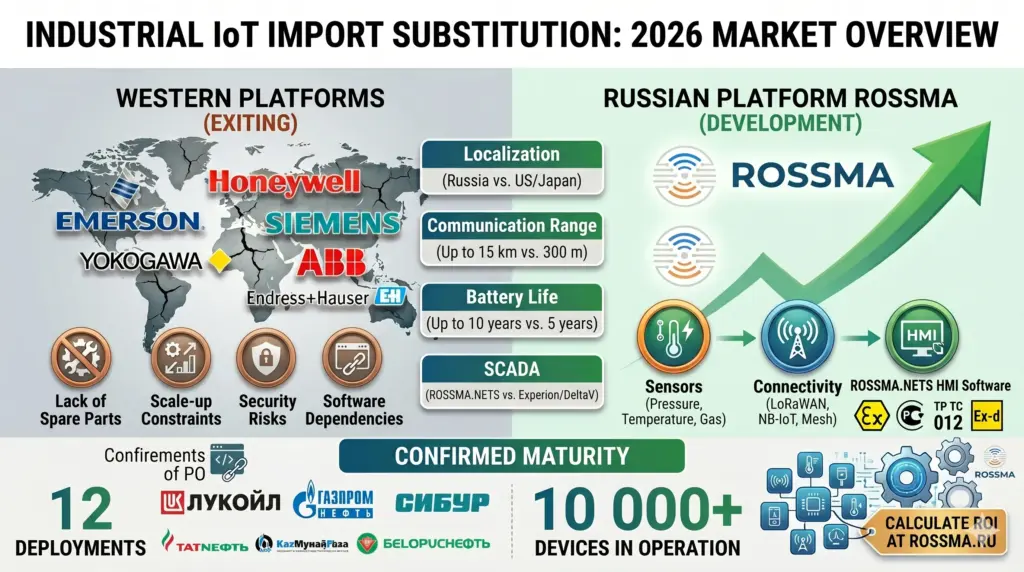
In total, ROSSMA has 12+ major deployments and 10,000+ devices across oil & gas, petrochemicals and utilities (LUKOIL, Gazprom Neft, Tatneft, SIBUR, Surgutneftegas and others).
How to start the switch to wireless monitoring
- Pick a pilot object — a wellpad, a pump station, a pipeline section
- Define the parameters — pressure, temperature, level, vibration
- Plan the network — use the LPWAN Network Planner to calculate coverage
- Install the pilot — 10–50 devices in parallel with the wired system
- Evaluate the result — compare data, economics, convenience
- Scale — phased migration to the remaining objects
Frequently asked questions
How reliable is the wireless channel at an industrial site?
LoRaWAN is resilient to interference and metal structures thanks to narrowband modulation and a large link margin (up to 15 km line-of-sight, hundreds of meters in dense layouts). On a brief link loss ROSSMA devices keep working autonomously and resend the archive on restoration — data is not lost.
How often do batteries need replacing?
A replaceable battery lasts about 3 years (depending on polling frequency and conditions). Replacement is done in minutes during routine maintenance, costs a few thousand RUB and requires no excavation or process stop.
Is it secure from a cybersecurity standpoint?
Yes. Data is encrypted on the device (AES-128) and decrypted only on the network server, the network runs in a private enterprise perimeter with no internet exposure, and devices authenticate by keys. Wired Modbus/HART, by contrast, often transmit data without encryption.
Can it integrate with our existing SCADA?
Yes. ROSSMA.NETS exposes data over Modbus RTU/TCP and OPC, so wireless devices connect to the existing upper level without replacing it — as in the LUKOIL project.
Is it suitable for hazardous areas?
Yes. ROSSMA devices are made in an explosion-proof Ex d version per TR CU 012/2011 (compatible with ATEX/IECEx) and operate in the −55…+85 °C range.
Is it better to replace everything at once or migrate in stages?
In stages. Start with a 10–50-point pilot in parallel with the wired system, compare economics and data, then scale. Critical fast loops and ESD can stay wired (hybrid scheme).
ROSSMA products to replace wired systems
- Pressure sensors — replacing wired 4–20 mA transmitters
- Temperature sensors — Pt1000, thermocouples, 1-Wire
- Vibration sensors — predictive equipment analytics
- LoRaWAN base stations — coverage up to 15 km
- WellPAD — a complete solution for wellpads
- Network Planner — online LPWAN network planning