Technology
Advanced wireless monitoring technologies for industrial facilities
LPWAN Technologies
LPWAN — Low-Power Wide-area Network
Our company is engaged in the production, design, consulting and expert services for our hardware and software systems operating on LPWAN technology. Low-Power Wide-Area Network (LPWAN) is a wireless technology for long-range transmission of small data volumes, designed for distributed telemetry networks, machine-to-machine communication and the Internet of Things. Our company produces hardware and software systems, such as IoT devices and automated process control tools, operating on LPWAN technology in LoRaWAN and NB-IoT networks.
ROSSMA is a member of the international community of equipment producers according to LoRaWAN standard – LoRa Alliance.

How it works
The basis of data transmission technology LPWAN principle at the physical level is the property of radio systems — energy increase, and hence the range of communication with a decrease in transmission speed. The lower the bit speed, the more energy is used in each bit and the easier it is to isolate it against the background noise in the receiving part of the system. Thus, low speed of data transmission allows to achieve greater range of their reception.
The approach used to build an LPWAN network is similar to the way mobile networks work. The LPWAN network uses a star topology where each device communicates directly with the base station.
A device or modem with an LPWAN module transmits data over a radio channel to the base station. The station receives signals from all devices within its range, and transmits to a remote server using an available communication channel: Ethernet, cellular, VSAT.
The data obtained on the server is used for display, analysis, reporting and decision-making.
Device management, software update occurs with the help of the reverse communication channel.
Application
The LPWAN technology is focused on the applications that require guaranteed transmission of a small amount of data, the possibility of long-term operation of network devices from autonomous power sources, large territorial coverage of the wireless network. The main areas of application of the LPWAN technology are wireless sensor networks, automatisation of meter readings, industrial monitoring and control systems.
Long transmission range
Coverage radius up to 45 km in line of sight, 5-10 km in urban areas
Low power consumption
Autonomous device operation on battery for up to 10 years without replacement
Unlicensed frequencies
Operation in the 868 MHz (ISM) band requires no licensing
High signal penetration
Excellent signal penetration in buildings, basements, industrial facilities
LoRaWAN = Long Range Wide Area Network
LoRaWAN — wireless communication protocol for IoT devices
LoRaWAN is an open standard developed and maintained by the LoRa Alliance. It provides bidirectional communication, end-to-end encryption, device mobility and localization. ROSSMA is a member of the LoRa Alliance.
The main competitive characteristics
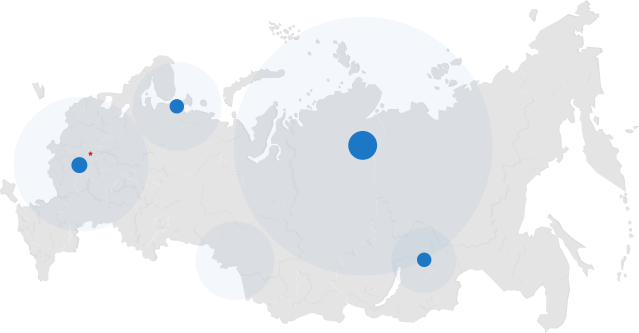
Large coverage range and easy network deployment
Allows subscribers to carry out data transmission over distances greater than the network of base stations of GSM standard. Coverage is created specifically for the client’s tasks. Not licensed frequency range.
Technology Comparison
| Technology Comparison | LoRaWAN | NB-IoT | LTE-M | WirelessHART |
|---|---|---|---|---|
| Spectrum | Unlicensed (ISM) | Licensed (LTE) | Licensed, LTE | Unlicensed (2.4 GHz) |
| Supported by | LoRa Alliance (IBM, Cisco, Semtech) | 3GPP (Ericsson, Nokia, Intel, Qualcomm) | 3GPP (Ericsson, Nokia, Intel) | FieldComm Group (HART) |
| Speed | 0.3–50 Kbps | < 150 Kbps | < 1 Mbps | 250 Kbps |
| Bandwidth | 125/250 kHz | 200 kHz | 1.4 MHz | 2 MHz |
| GSM energy budget improvement | +20 dB | +20 dB | +12 dB | N/A |
| Frequency reuse | 1 | 7–9 (2G), 1 (LTE) | 1 | TDMA |
| Private network support | Yes | No | No | Yes |
| Module battery life | 10+ years | 10 years | Up to 10 years (PSM) | 3–5 years |
| Availability | Available | Available (since 2018) | Limited | Niche (industrial) |
| Range | 15–45 km | 10–15 km | 10–14 km | 200–250 m |
| Network topology | Star-of-stars, Mesh (relay) | Star | Star | Mesh (self-organizing) |
| Bidirectional communication | Yes (Class A/B/C) | Yes (full) | Yes (full, VoLTE) | Yes (full) |
- Spectrum
- Unlicensed (ISM)
- Supported by
- LoRa Alliance (IBM, Cisco, Semtech)
- Speed
- 0.3–50 Kbps
- Bandwidth
- 125/250 kHz
- GSM energy budget improvement
- +20 dB
- Frequency reuse
- 1
- Private network support
- Yes
- Module battery life
- 10+ years
- Availability
- Available
- Range
- 15–45 km
- Network topology
- Star-of-stars, Mesh (relay)
- Bidirectional communication
- Yes (Class A/B/C)
- Spectrum
- Licensed (LTE)
- Supported by
- 3GPP (Ericsson, Nokia, Intel, Qualcomm)
- Speed
- < 150 Kbps
- Bandwidth
- 200 kHz
- GSM energy budget improvement
- +20 dB
- Frequency reuse
- 7–9 (2G), 1 (LTE)
- Private network support
- No
- Module battery life
- 10 years
- Availability
- Available (since 2018)
- Range
- 10–15 km
- Network topology
- Star
- Bidirectional communication
- Yes (full)
- Spectrum
- Licensed, LTE
- Supported by
- 3GPP (Ericsson, Nokia, Intel)
- Speed
- < 1 Mbps
- Bandwidth
- 1.4 MHz
- GSM energy budget improvement
- +12 dB
- Frequency reuse
- 1
- Private network support
- No
- Module battery life
- Up to 10 years (PSM)
- Availability
- Limited
- Range
- 10–14 km
- Network topology
- Star
- Bidirectional communication
- Yes (full, VoLTE)
- Spectrum
- Unlicensed (2.4 GHz)
- Supported by
- FieldComm Group (HART)
- Speed
- 250 Kbps
- Bandwidth
- 2 MHz
- GSM energy budget improvement
- N/A
- Frequency reuse
- TDMA
- Private network support
- Yes
- Module battery life
- 3–5 years
- Availability
- Niche (industrial)
- Range
- 200–250 m
- Network topology
- Mesh (self-organizing)
- Bidirectional communication
- Yes (full)
Problems Solved by LoRaWAN
No power supply
No electrical power for field sensors and meters
No GSM coverage
Lack of or insufficient GSM network coverage for data transmission
Interface heterogeneity
Diverse interfaces for collecting data from instrumentation and automation controllers
Expensive wiring
Expensive installation of wired lines for instrumentation (control and power cables)
Narrow Band Internet of Things
NB-IoT — Protocol for IoT Devices on Mobile Networks
It is intended for connection to digital communication networks of a wide range of autonomous devices. For example, medical sensors, resource consumption meters, smart home devices, etc.
It is mainly used in urban areas with high density coverage of cellular networks GSM. In everyday life, such communication systems are called the Internet of things.
NB-IoT is one of three IOT standards developed by 3GPP for cellular networks: eMTC (enhanced Machine-Type Communication), NB-IoT and EC-GSM-IoT. eMTC. has the highest capacity and takes place on the LTE equipment.
NB-IoT network can be deployed on the equipment of cellular networks LTE, as well as separately, including on top of GSM. EC-GSM-IoT provides the lowest bandwidth and is deployed above GSM networks.
Flexible power management
Battery operation from 5 Wh battery for up to 10 years
Massive network capacity
Tens to hundreds of thousands of devices per base station
Optimized modulation
Improved receiver sensitivity for better coverage
Low device cost
Simple chipset optimized for IoT tasks
Frequently Asked Questions
What is the difference between LoRaWAN and NB-IoT?
What is the communication range of ROSSMA devices?
Can the equipment be used in explosive atmospheres?
Which communication protocol should I choose?
How many sensors can connect to one base station?
How long do sensors last on battery?
Can it integrate with existing SCADA or MES?
Is a frequency license required for LoRaWAN?
How is data transmission security ensured?
What do I need to start a pilot project?
Discuss a project
Contact us to select the optimal technology for your project