Utility Automation: Wireless Monitoring of Building Systems
How to automate water, heat and gas metering in buildings without wiring. LoRaWAN Mesh monitoring, up to 30% resource savings.
The Problem: Manual Control, Resource Losses and Emergencies
Utility companies, water utilities and heat supply organizations face systemic problems daily that cannot be solved without automation.
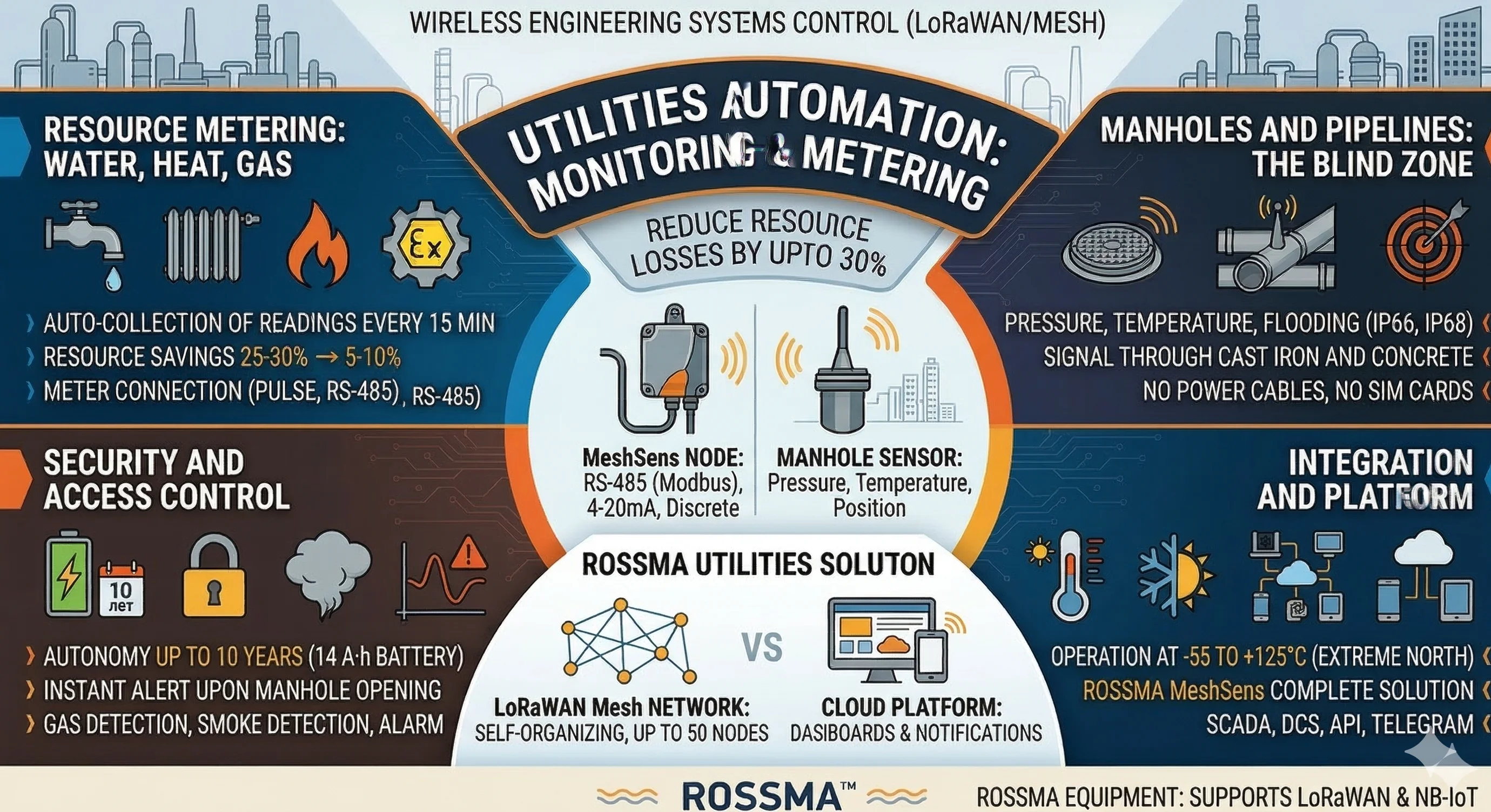
Metering and Resource Accounting
- Manual rounds — inspectors visit basements, heat substations, metering nodes, manholes, recording readings by hand
- Resource losses up to 25–30% — discrepancy between building-level and apartment-level meters. Without real-time data, leaks go undetected for weeks
- Outdated data — readings collected once a month, decisions based on month-old information
Pipelines and Manholes — the “Blind Zone”
Underground utilities are the most vulnerable part of city infrastructure. Water and heat pipelines run through manholes and collectors where:
- No connectivity — concrete walls, cast iron covers, soil block cellular signal. NB-IoT and GSM don’t work
- No electricity — running a power cable to a manhole costs from $1,000 and requires permits
- No pressure monitoring — pressure drop indicates a leak, but without sensors it’s only discovered when water surfaces
- No temperature control — pipe freezing at -40°C in winter, heat main overheating in summer
- Manhole flooding — groundwater, pipe bursts. Flooded manholes mean equipment corrosion
Manhole Cover Access Control
- Safety hazard — pedestrians and vehicles falling into open manholes, lawsuits
- Theft — cast iron covers sold as scrap metal
- Vandalism — unauthorized access, illegal pipe taps
Safety
- Gas leaks — in basements, boiler rooms, gas distribution points
- Smoke — fires in electrical rooms, basements, technical premises
- No alerts — dispatcher learns from residents, not from the system
Solution: Wireless IoT Monitoring
Wireless IoT systems automatically collect data from meters and sensors every 5–60 minutes. Data flows to a cloud platform where the dispatcher sees all facilities on one screen.
What Can Be Monitored
Pipelines in Manholes
- Pipeline pressure — ROSSMA P-METER installed directly in manholes. ±0.2% accuracy, background monitoring every 5 seconds
- Heat main temperature — ROSSMA 1-Wire with DS18B20 sensors (-55…+125°C). Up to 5 measurement points per device
- Manhole flooding — ROSSMA Leak Detector at manhole bottom. Instant alert + audible siren
- Valve position — ROSSMA Dry Contact VPM measures valve opening percentage (0–100%)
Manhole and Cabinet Control
- Cover opening — ROSSMA Dry Contact detects opening/closing, instant alert to dispatcher
- Theft protection — ROSSMA ESD detects vibration, impact, tilt >15°
Safety
- Gas detection — ROSSMA Gas Analyzer Ex in basements, boiler rooms
- Smoke detection — ROSSMA Smoke Detector in electrical rooms
- Panic button — ROSSMA Alarm Button for maintenance crews working in manholes
Economic Impact
| Metric | Before | After IoT |
|---|---|---|
| Meter reading | Monthly (manual) | Every 15 min (auto) |
| Leak detection | Days–weeks | Seconds (instant alert) |
| Resource losses | 25–30% | 5–10% |
| Manhole control | Quarterly inspection | Continuous |
| Communication cost | SIM per device | $0 (own LoRaWAN network) |
| ROI | — | 6–12 months |
Conclusions
Utility automation with ROSSMA IoT pays for itself in 6–12 months. Wireless sensors work in manholes, basements, underground — where cellular networks fail.
Need a cost estimate? Contact us or use the AI Equipment Selector.