Autonomous Well Pad
Data Acquisition System
Oil & gas well pad automation based on the ROSSMA IIoT-AMS platform: wireless sensors, edge server, unified software
Problems of Traditional Monitoring
Challenges faced by oil & gas enterprises without modern automation
Manual Inspection
Up to 24-hour delay in incident detection. Operators physically drive to wells.
Downtime Losses
5–15 tons of oil per incident. Delayed response to equipment failures.
Expensive Wired Solutions
3–6 M₽ per well pad. Cable routing in harsh conditions.
Remote Locations
No stable connectivity or infrastructure at field sites.
System Architecture
Four levels: from field sensors to enterprise systems
Equipment Lineup
Explosion-proof field devices for autonomous data acquisition
P-METER
Ex pressure sensor. LoRaWAN / NB-IoT.
1-Wire Ex
Ex temperature sensor. 1-Wire bus.
ANALOG Ex Single
Ex analog converter. 4-20 mA.
Modbus
Modbus RTU to LoRaWAN converter.
Dry Contact VPM
Pulse counter and dry contact sensor.
Gas Analyzer
Ex combustible gas detector. CH₄, C₃H₈.
ESD
Emergency shutdown device Ex.
Pulse
Flow meter pulse counter.
Software
Unified ecosystem for device management and data visualization
ROSSMA IIOT-NETS
Telemetry collection, storage, and processing server.
NETS.HMIDevice Configurator
LoRaWAN device parameter configuration tool.
Network Planner
Wireless network topology planning tool.
Pipeline Leak Detector
Pipeline leak detection system.
Compatible with: Astra Linux • Kaspersky • CII / FSTEC • Domestic Software Registry
Typical Well Pad Configuration
Example setup for a pad with 8 wells
| Object | Parameters | Device | Points |
|---|---|---|---|
| Wells (8) | Pressure, temperature | P-METER, 1-Wire Ex | 16 |
| Separator | Pressure, level, temperature | ANALOG Ex, P-METER | 3 |
| Tanks (2) | Level, temperature | ANALOG Ex, 1-Wire Ex | 4 |
| AGZU | Flow, pressure | Pulse, P-METER | 3 |
| Valves | Position, control | Dry Contact VPM, ESD | 2 |
| Gas Analyzer | CH₄, C₃H₈ | Gas Analyzer | 1 |
| Security | Perimeter, access | Dry Contact VPM | 1 |
~30 points · 1 base station · 1 edge server · LTE uplink
WellPAD Automation Cabinet
WellPAD automation cabinet components for autonomous pad operation
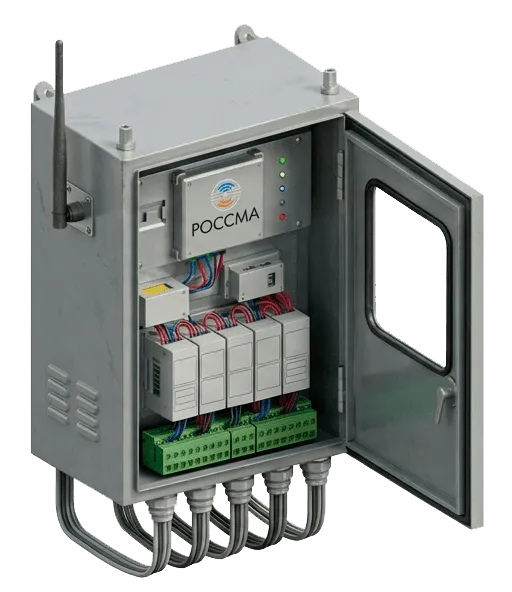
Base Station
VEGA 2.2 or RAK 7289CV2. Up to 2000 devices, 8 channels, GPS.
Industrial PC
Fanless, -40..+70°C, 2×LAN, SSD, DIN rail mount.
ROSSMA IIOT-NETS
Containerized platform: ChirpStack, TimescaleDB, Web-HMI.
Power Supply
AC 220V / DC 24V, UPS 4h, lightning protection.
Communications
LTE modem with MIMO antenna, VPN to control room.
Protection
IP65 climate enclosure, heating, ventilation.
Solution Economics
Comparison with traditional wired SCADA systems
| Wired SCADA | ROSSMA WellPAD | |
|---|---|---|
| Cost per pad | 3–6 M₽ | 1–1.5 M₽ |
| Installation time | 2–4 months | 1–2 days |
| Cable routing | Required | Not needed |
| Maintenance | Regular | Minimal |
ROSSMA IIOT-WellPAD Advantages
Comprehensive solution for well pad digitalization
10-Year Autonomy
Lithium batteries, ultra-low power Class A LoRaWAN.
45 km Range
LoRaWAN in open terrain. NB-IoT / LTE as backup.
Ex-proof
All field devices certified Ex ia IIC T6.
Cable-free Install
Wireless architecture — deployment in 1–2 days.
CII / FSTEC Compliant
Meets critical information infrastructure requirements.
Edge Computing
Local processing on edge server, autonomous on link loss.
Certification & Compliance
Complete regulatory documentation package
TR CU 012/2011
Customs Union technical regulation compliance certificate.
CII / FSTEC
Critical infrastructure security requirements compliance.
Domestic Software Registry
ROSSMA IIOT-NETS listed in the Unified Russian Software Registry.
LoRa Alliance
Certified LoRaWAN devices, compatible with any network server.
Astra Linux + Kaspersky
Compatible with Russian OS and information security tools.
3-Year Warranty
Extended warranty on hardware and software.
Get a Project Estimate for Your Oilfield
Our engineers will prepare a custom specification and proposal for your well pad